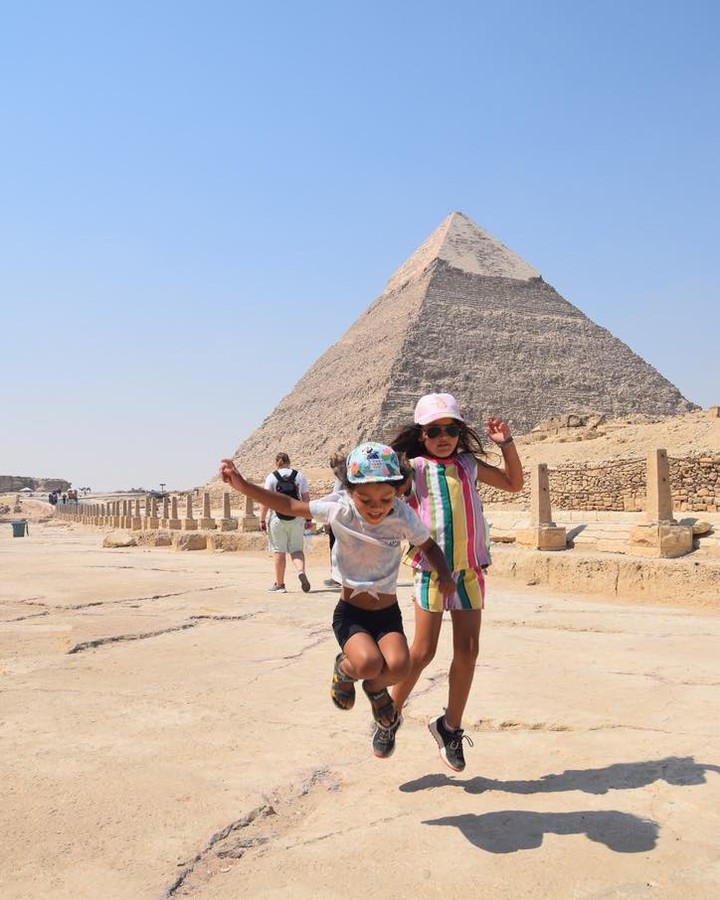
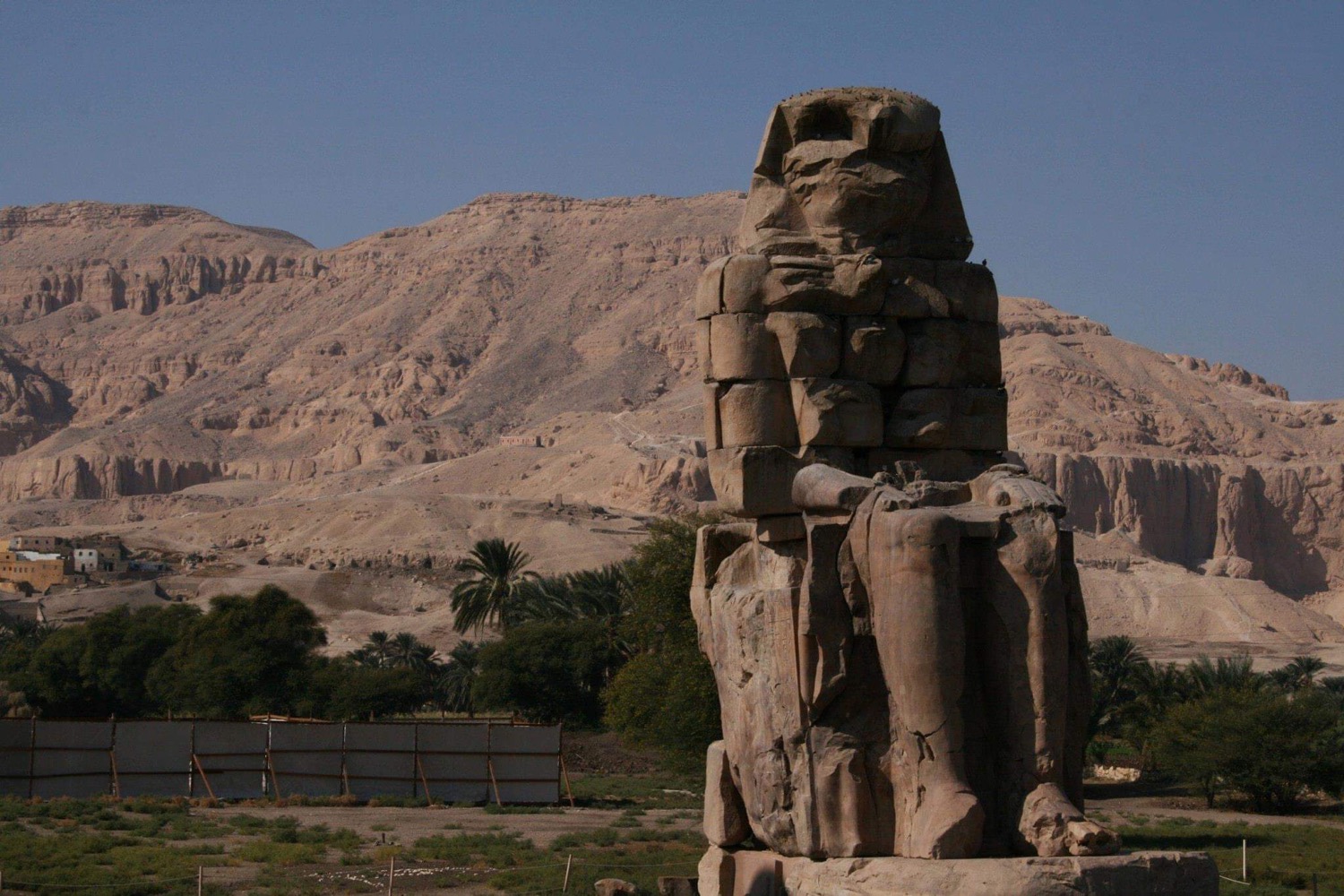
Travelling through Egypt with five-year-old Jaïra and four-year-old Joëlla: Cairo, the pyramids, Soma Bay, Luxor, Aswan and Abu Simbel. Our stories and photographs from August 2021.
Our trip through Egypt · 2021
Egypt on the map: open a photo album
From the Nile Delta on the Mediterranean to Aswan, you can see how the river runs through Egypt. Open a photo pin for that place’s album and follow the link to its story. Abu Simbel lies farther south, beside Lake Nasser.
The pins show the places we visited approximately, rather than the photographer’s exact position.
Browse all locations (29)
Cairo & Giza
Red Sea
Luxor
Aswan & Abu Simbel
From our 2021 trip
Our Egypt stories
From preparing at home to the pyramids of Saqqara. Open a story to read it in full. Travel information and prices in these diaries relate to our trip in 2021.
Egypt 2021 | Preparing for the trip
For a very brief moment, it looked as though travelling this summer might be possible again. We could daydream about lovely trips around Europe. But it soon became clear that there would still be plenty of complications. Would we be vaccinated in time? Were there entry restrictions, and what could we actually do? So much uncertainty…
But the urge to travel again was stronger than our worries about tests and travel restrictions. After a bit of research, Egypt turned out to be relatively straightforward to reach. As it happens, I (Marcel) lived in Egypt for a while, which also explains my love of the Middle East. Egypt required a negative PCR test before boarding the plane. That seemed manageable! We also still had family and friends living there, so in the worst case we could fall back on working remotely from a flat.
We decided to go to Egypt in May. Now, in July, it turned out that a negative PCR test was also among the requirements within the EU. With Spain carrying an orange travel advisory too, the difference between the two destinations had rather disappeared. People would undoubtedly have opinions about our decision, but let's be kind to one another. Everyone makes their own choices.
Egypt it was! I had always wanted to show the country to my wife and children. Honestly, though, the mass tourism had kept making me put it off. With fewer tourists around, this seemed the moment to go. The main things to arrange before leaving:
Check our travel vaccinations. We use thuisvaccinatie.nl. Safety always comes first, especially for the children!
Book a PCR test.
Remove the Israeli stickers from our passports…
Yes, you read that correctly. We had been to Israel before. Although they use a separate paper slip instead of stamping your passport, they still put a sticker on it when handling your luggage. Not every country in the Middle East welcomes a previous visit to Israel, so we preferred to remove those stickers and avoid awkward discussions.
We first contacted Egyptair about the flights. Their website set out the coronavirus rules very clearly. Egyptair might be a middle-of-the-road airline, but compared with other airlines we felt much more confident that its flights to Cairo would actually operate.
Egypt 2021 | Getting the children ready
Getting the children ready
Egypt in summer might be the daftest trip you could plan. I'll admit that. It is essential to realise just how hot it can get: temperatures of 40 degrees are the rule rather than the exception. Our children are used to quite a bit, but it was still something we needed to take into account!
We always involve the children in preparing for a trip. That was fairly easy with Egypt, because few countries are so easy to picture. We showed them lots of photographs and videos. Through Google, for example, we found a series of Schooltv films about Egypt.
There were several episodes in which a talking cat explained life in ancient Egypt. My daughters loved them. Questions such as 'Do they still wear those clothes?' and 'How do they build pyramids?' soon followed!
I then watched The Prince of Egypt with my five-year-old daughter. She found it quite exciting! What I loved was that she connected the cartoon with Bible stories, and then linked those stories to our trip to Israel. Gradually, she became interested in more than Egypt's swimming pools. Now there were pyramids, temples, the desert and camels too. They are actually dromedaries in Egypt, but I'll let that one pass.
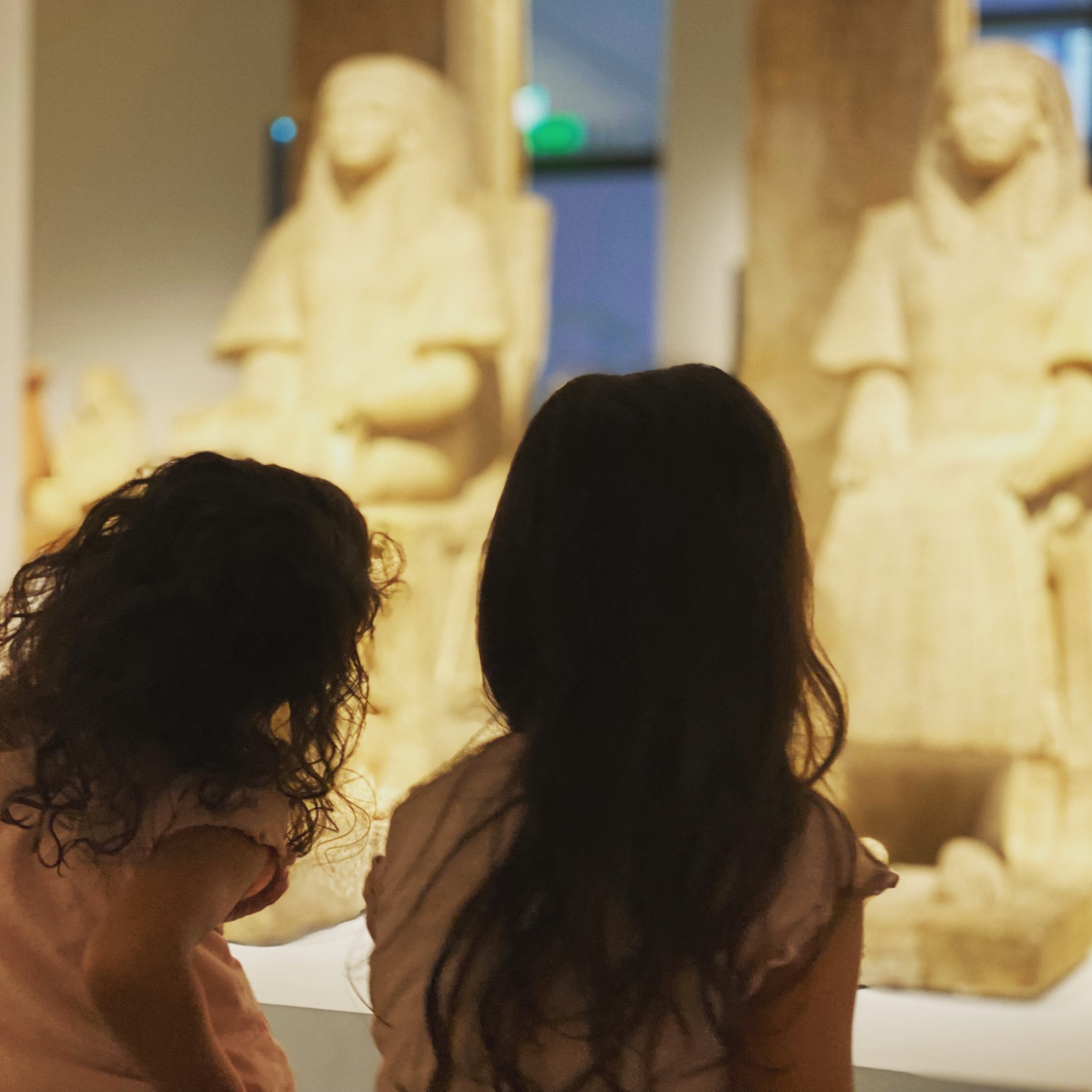
Another brilliant tip is to visit the National Museum of Antiquities in Leiden. I would encourage anyone with children to visit more museums anyway, but that's another story. This museum has a permanent Egyptian collection of more than 1,400 objects. Mummies, statues, everyday items: a bit of everything. And they had a children's treasure hunt called 'In search of the pharaoh'. What more could you want?
Jaïra, five, wandered through the museum, completely absorbed in what she saw. Strange statues, scary mummies and comments such as 'That looks like a slipper.' When your five-year-old daughter stands in front of a statue of Ramses and says, 'Isn't that Moses' brother?', you know some of it is sticking. That made me very happy.
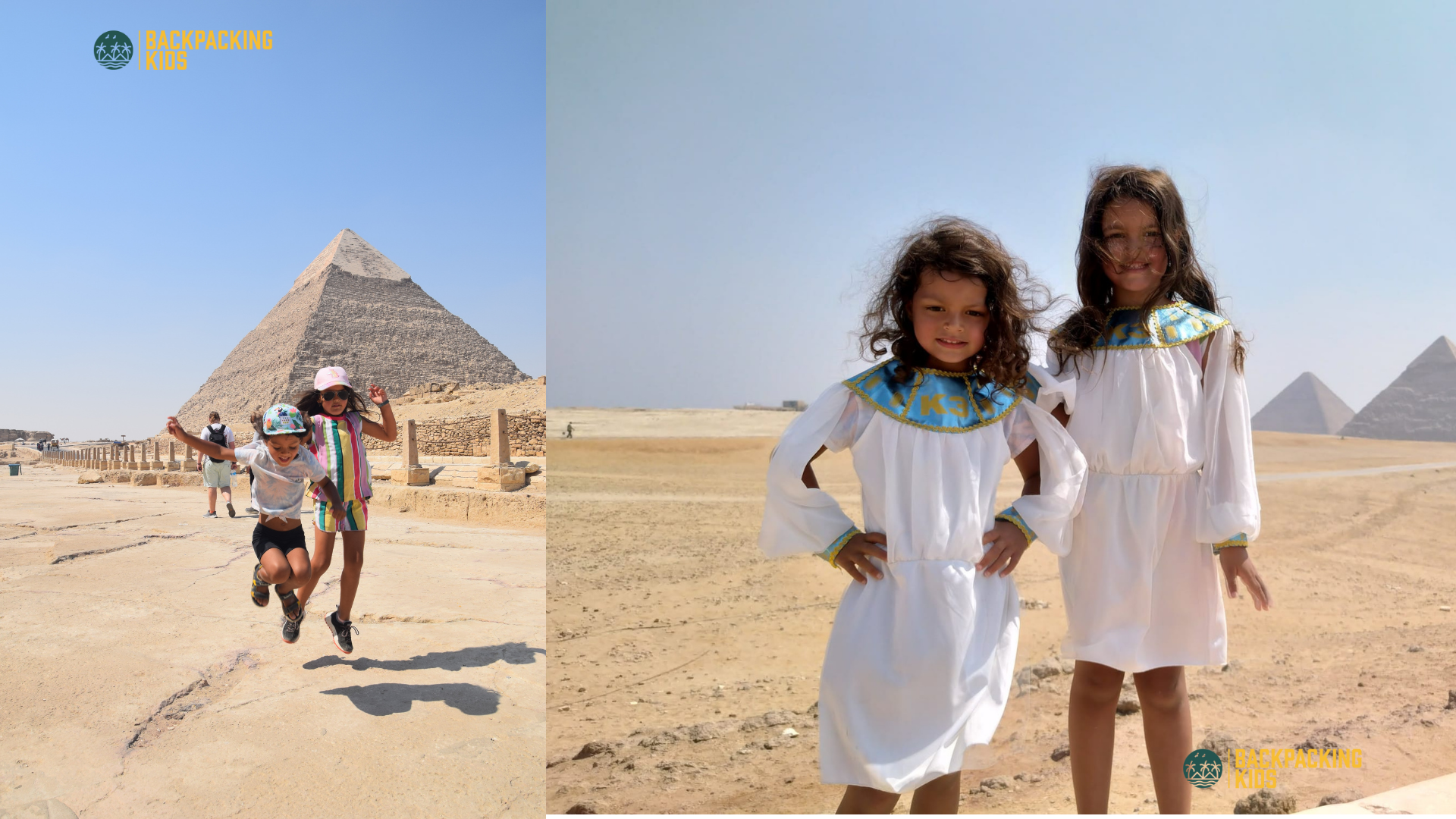
After the museum, I took my daughters to see the K3 film Dans van de Farao, to get a little more of that Egyptian atmosphere. These may seem like small things, but they really help children get excited about an upcoming trip. By now they had a rough idea of what we would be doing in Egypt, and that it could be incredibly hot. Above all, though, they kept dancing to the song Dans van de Farao in their Egyptian K3 dresses.
Although I couldn't bear to hear the song, or K3, one more time, it was very sweet to watch.
Mind your step
Today, 7 August 2021, was finally the day: we could get on a plane again! Preparing for this trip had been much more involved than usual. Every few days we checked the travel advice and adjusted our plans accordingly. But there we were, at Schiphol.
With two PCR tests, proof of recovery and full vaccinations, we were holding a sort of pandemic bingo card. Yes, two PCR tests. After hearing so many stories about the government's free test results arriving too late, we weren't going to rely on that test alone. Besides, we had already arranged another one long before the free testing scheme was announced.
Anyway, we were ready to leave safely. At Schiphol, the effect of COVID-19 on travel was immediately obvious. The airport was empty, almost everyone wore a face mask, and it was unusually quiet.
Egyptair opened its check-in desks well ahead of departure, as we had hoped. We could check in three hours before our flight. Security came next, and of course one of our children had to be searched again. Four-year-old Joëlla must have a criminal-looking face.
Hearing 'mind your step' made me feel positively euphoric. How I had missed travelling, exploring and meeting people. Making memories that stay with you for years. Egypt, here we come!
We soon had confirmation that we were indeed going to Egypt. Although we had been asked to be at the gate at 15:45 for boarding, the plane hadn't even arrived. Half an hour later, we watched it land and taxi in, then saw the passengers get off. Watching the luggage was quite entertaining. We kept the children busy for at least twenty minutes looking out for our bags. And yes, they spotted them!
Bag on the belt, bag goes up, bag almost reaches the aircraft, bag falls down. 🤦🏼♂️ We finally boarded more than an hour late. People sometimes say not to expect KLM-style luxury with Egyptair, but honestly, I couldn't immediately see what they meant.
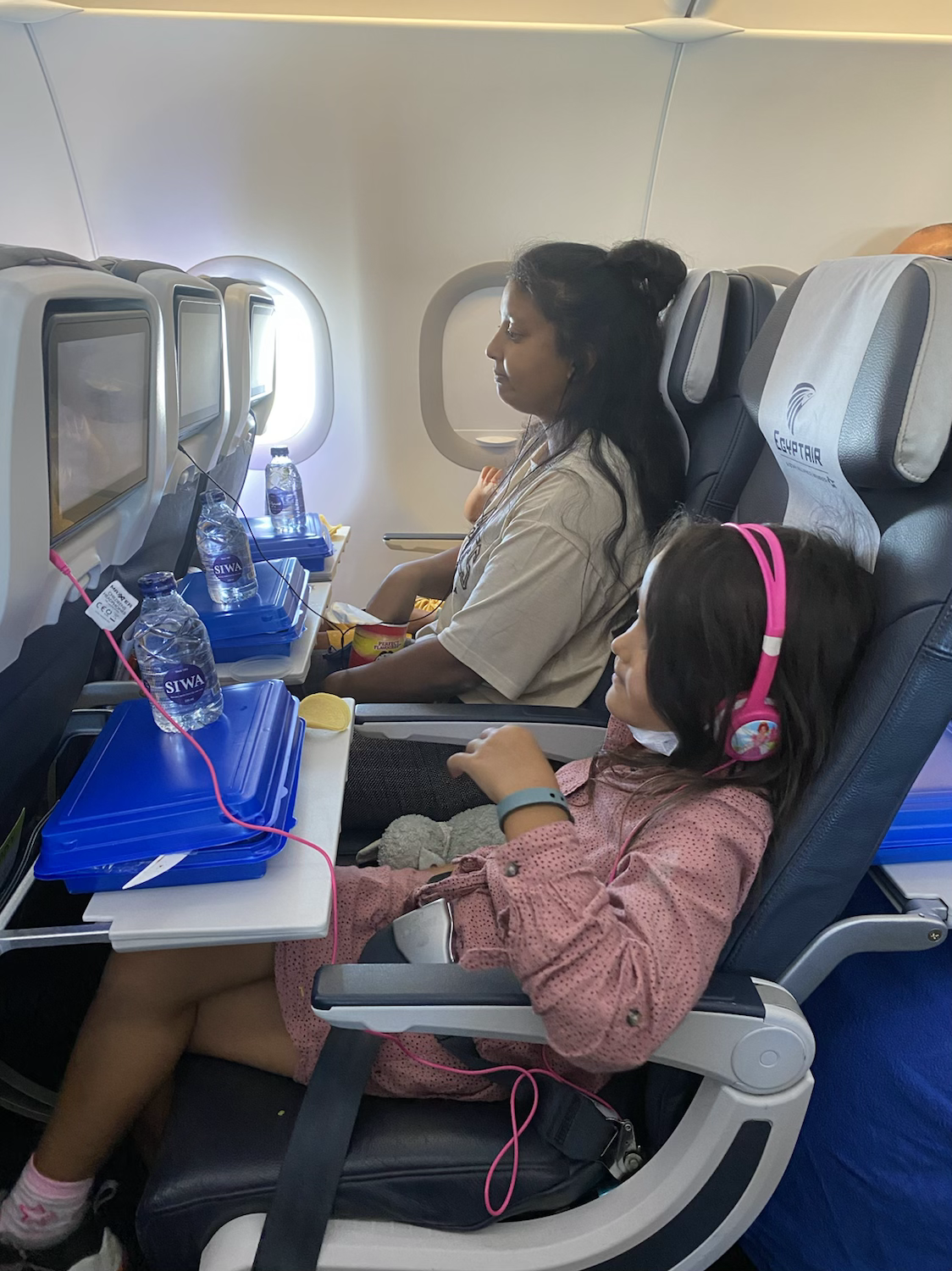
All right, the flight was delayed. Perhaps the aircraft didn't look as smart as a KLM plane. But the friendliness of the staff, especially towards children, immediately made up for it. As we were on a scheduled flight to a country with an orange travel advisory, most passengers were Egyptian or Dutch with an Egyptian background. Arabic was the language on board.
The friendliness was obvious straight away, something I often associate with Arab hospitality. The man in front of me saw Jaïra and immediately said in English, 'She can have my seat, next to my daughter. Then they can play together.'
Even better was the conversation with the man beside me. He asked about my T-shirt. I was wearing one with the backpackingkids.nl logo and 'backpackingkids' written across the back in big letters.
We got talking. Hoksha thought it was wonderful that we were taking the children to less obvious places. He appreciated that we wanted to show them Egypt. It turned out that he also lived in Rotterdam, a stone's throw from our home. He had been living there for work for a few years.
We had a lovely conversation about travelling, Egypt and Cairo. He gave me his number and asked me to keep in touch. He wanted to show us the real Cairo. These encounters are exactly why we travel.
At around 21:00, the plane touched down and we were introduced to chaotic Cairo. First came the queue for the coronavirus check. Then our contact met us and took us to the visa check. I handed over some money, he bought a visa, and before long we were queuing again. Typical Egypt. At counter one you buy a visa. At counter two they stamp it. At counter three they check the stamp from counter two.
At least our bags were ready. One more queue at the exit for the baggage check, and we were done. Fortunately, we had the children with us. Seeing that they needed their beds, the customs officer let us walk around the scanner. At 22:30, we stepped out, unchecked, into Cairo's 32-degree heat. Time for our first hotel!
The Cairo museum: our first introduction to Egypt
Cairo, day one
The alarm went off early, and by 07:00 we were having breakfast. In this heat, especially with children, you really have to divide up the day. Go out in the morning, rest in the afternoon and head out again later on.
We were staying at the Hilton, on the bank of the Nile and behind the Egyptian Museum. We know there is a contradiction between backpacking and staying at the Hilton. But there was a reason. With all due respect, Egypt wasn't at the top of our list for hygiene. And although we were travelling again, COVID-19 was still around. Choosing a good, clean hotel was the least we could do to protect ourselves, the children and, ultimately, others. Better safe than sorry!
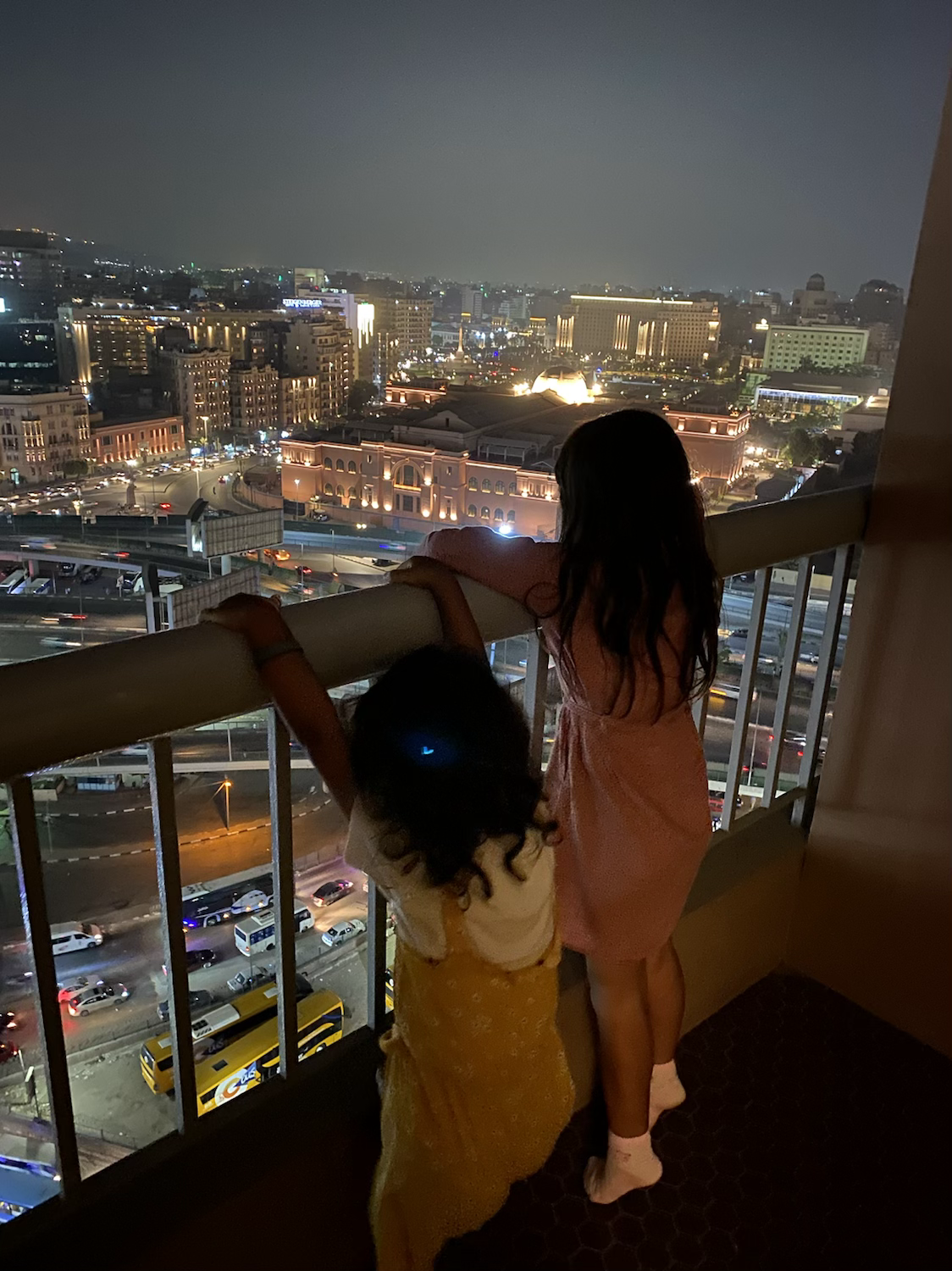
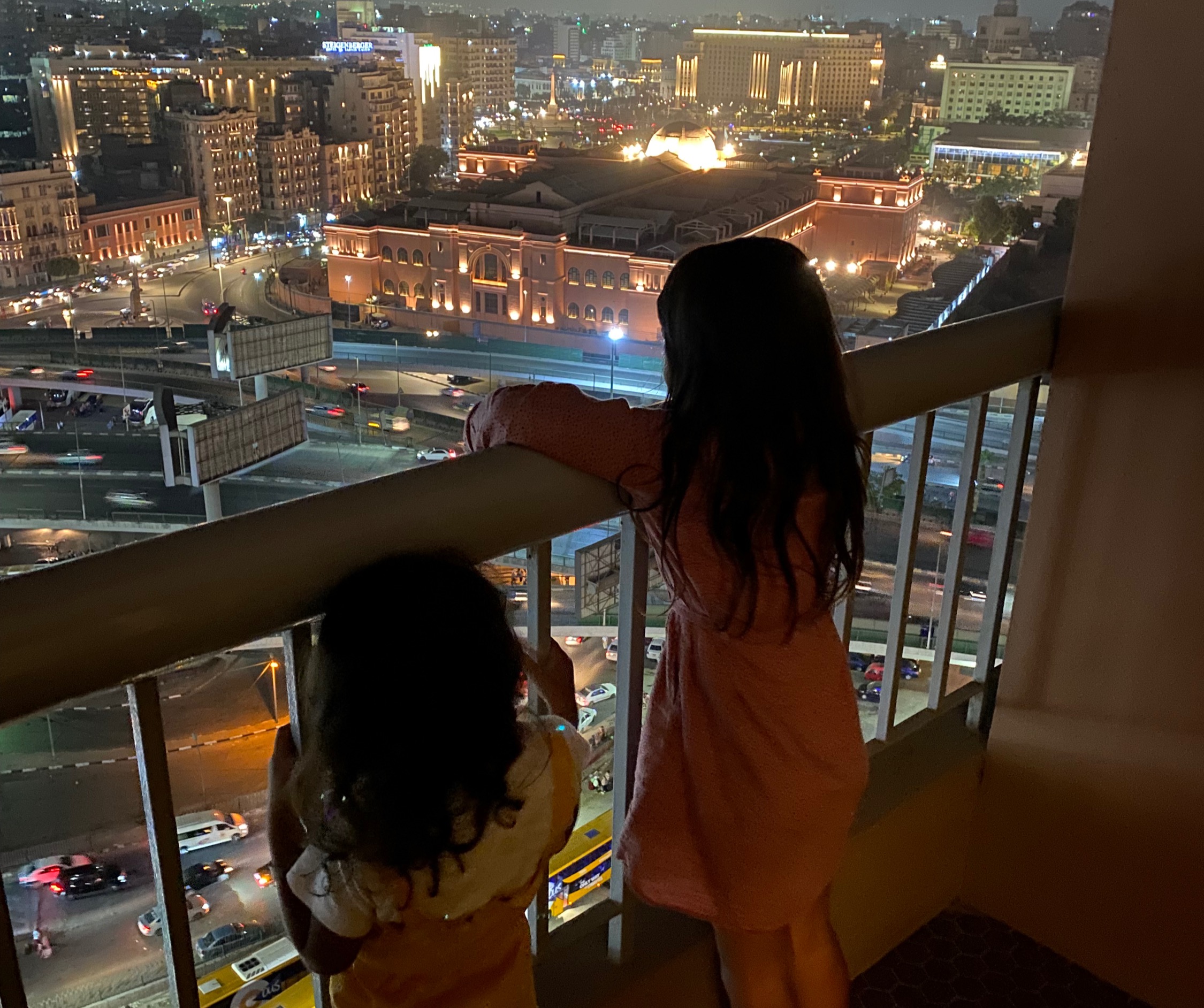
We had arrived the previous evening. The first thing we showed the girls was the 'pink palace' we would visit the following day. Normally, we would have been happy with something simpler, but this was the right hotel for us then. And before you get carried away, these were five Egyptian stars. It was fine, but it was an old, rather worn hotel with fantastic staff! Breakfast at 07:00 was rush hour, but the food was good nevertheless.
Our first aim was to visit Tahrir Square, near the museum. This famous square played a central role in the revolution. The revolution had changed a great deal in Egypt. Tourism collapsed, and just as it was recovering in the winter of 2018, coronavirus knocked it back again. You could see the effects everywhere. There were hardly any tourists. Our hotel, for example, was full of Arab visitors, including Saudis, with few Europeans. Many of the Europeans we did see were Italian.
So far, the children thought everything was wonderful. That soon changed. 😂
Between the hotel and the museum was a road. Quite a road, too: a huge junction with slip roads, a bus station and taxi ranks. No traffic lights. Add an average of about 1.8 cars per lane, and the common habit of moving to the far-right lane before turning left, and you can imagine what an experience it was.
I won't lie: we held the children tightly by the hand and did what the Egyptians did. Jaïra found it frightening. After our third crossing, she cried. The heat, the constant honking and the roads had become too much. We changed our route and walked through a quieter part of Cairo. We lost count of the looks the girls attracted and the comments that I must be a 'lucky man'. After a walk, we decided to find a drink and some air conditioning. It wasn't even 08:00, and it was already over 30 degrees.
Our first proper stop was the Egyptian Museum. A large pink building with an extraordinarily valuable collection. The museum felt dated, with a presentation from around 1980, but this was the Cairo museum to visit. At the time, work was continuing on the enormous new Grand Egyptian Museum, or GEM. It was set to become one of the world's largest museums, although its opening had already been delayed by a year and a half, with COVID given as the reason. We could have plenty to say about that, but our own government and deadlines aren't exactly a perfect marriage either.
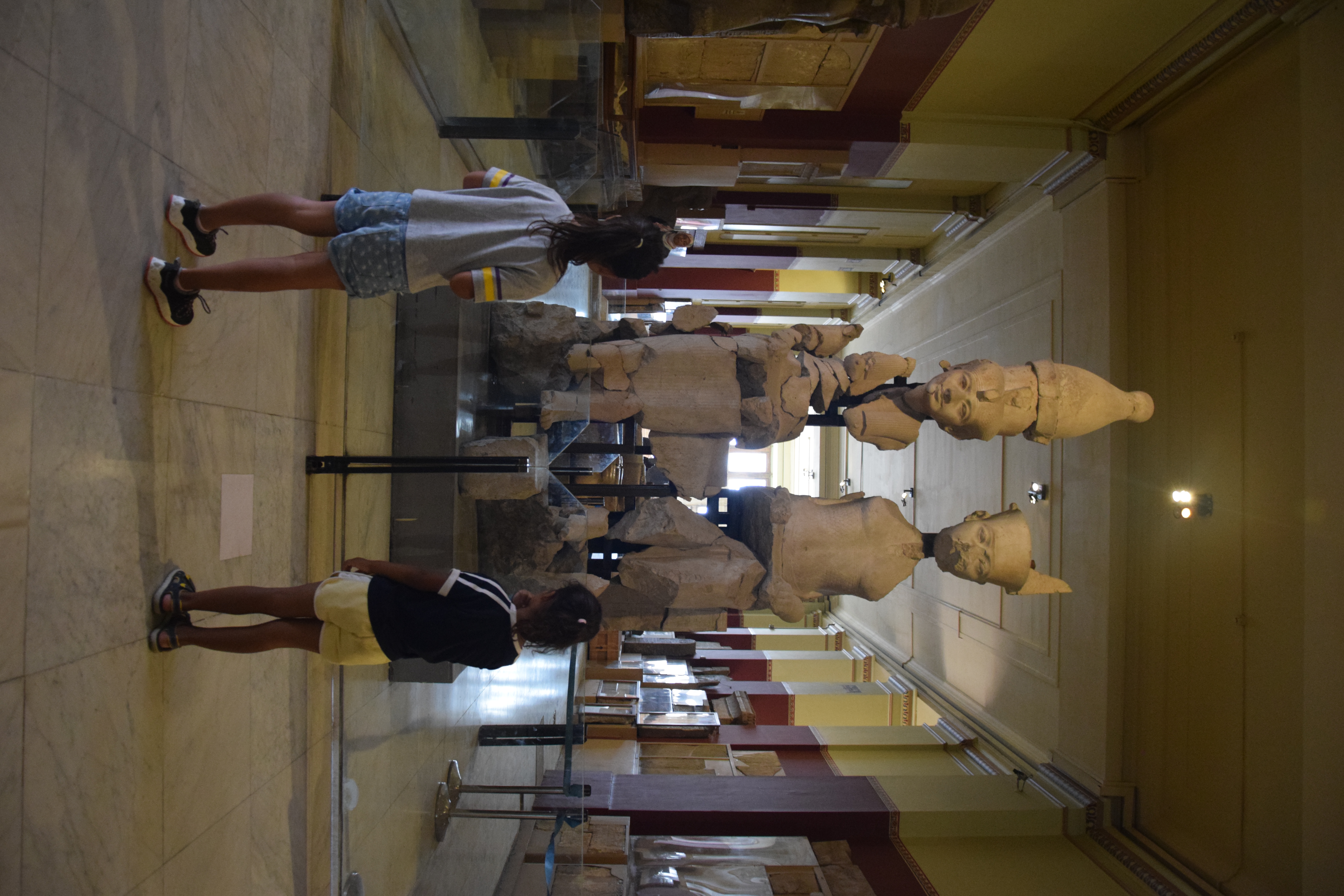
Some objects had already been moved out, making the old museum look even more worn. Walking through such an empty museum felt surreal. Even with items missing, it was still crammed with objects. It was the tourists who were missing.
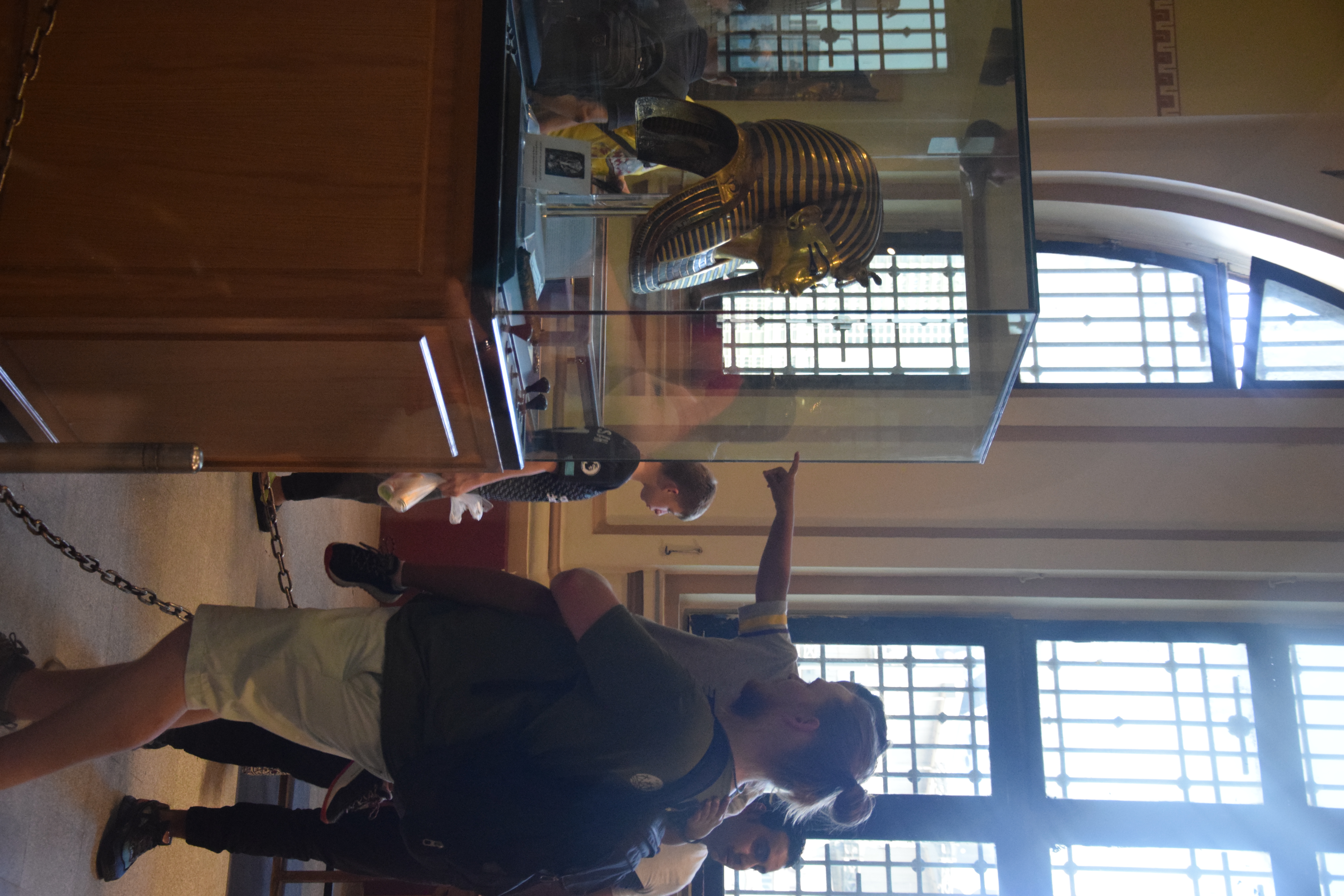
The children couldn't take their eyes off everything! They recognised things from the museum in Leiden and from all they had learnt in the previous weeks. We went looking for the treasure: Tutankhamun's mask. Normally, this part of the museum was so busy that you had to pay extra, but now we could walk around quietly.
The children came face to face with that ridiculously beautiful, valuable mask. The gold, the detail, the sheer splendour. Just wow!
What was lovely about this museum was that they could relate the objects to things we use today. We made our way through it playfully.
For us, this museum was a must-see. If you have the chance, it belongs on that list of museums to visit at least once. Back then, our advice was that if you could wait for the GEM, you should. Otherwise, you would simply HAVE to come back!
After the visit, we had promised the children a swim, so that we could head out again in the afternoon. That is part of travelling with children too: making compromises.
Just before lunch, the girls were back in the pool. Only four and five, but already real water babies. We joined them, because 40 degrees in the city was a challenge for us too. And a little holiday time during a trip is hardly a bad thing, is it?
In the next story, we'll take you through old Islamic Cairo!
Islamic Cairo with children
Islamic Cairo
After a morning walk around Cairo and a visit to the museum, we had a second activity planned.
Before we had even booked the trip, a mutual contact introduced me to Mohammed Swefy. Swefy is from Cairo and works as a guide, with a particular interest in Islam and its history. We had agreed a good price online. The idea was to explore old Islamic Cairo. At the last minute, we moved our meeting a little later because of the heat, and because our water babies refused to leave the pool.
Swefy asked us to meet him at the Al-Azhar Mosque. We arranged a taxi and set off. We drove deeper and deeper into Cairo. There were hardly any tourists anywhere, but I was certain we wouldn't find any here. The taxi driver asked us twice, 'Are you sure?'
We are used to quite a bit, so I wasn't worried. The journey took about half an hour. The girls leaned against Mum and closed their eyes. Whenever we get into a taxi, we suggest a little nap so that they'll have more energy later. By now, they understood the idea and wanted to do it themselves. That's the first small victory when travelling with children!
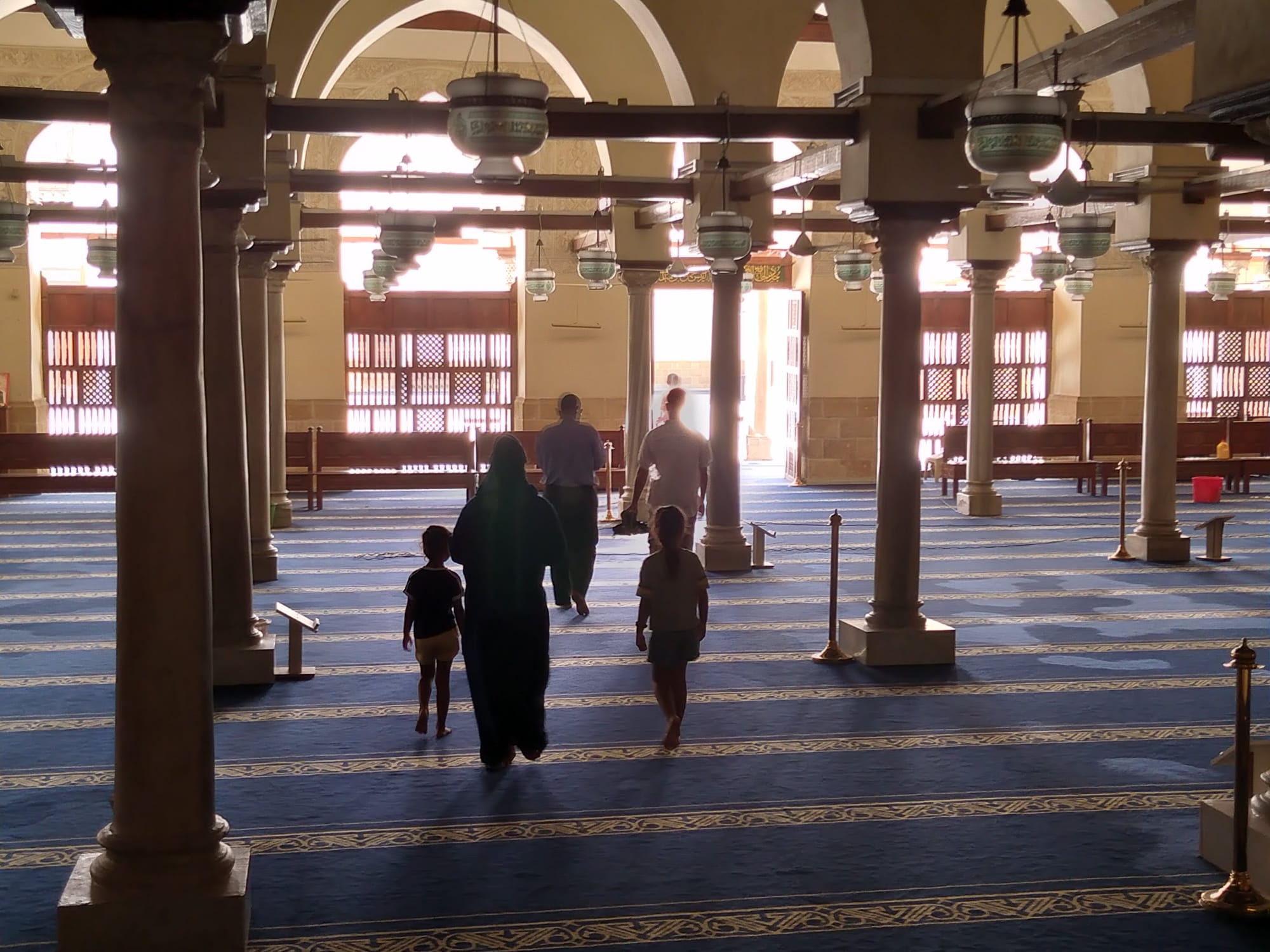
Swefy was indeed waiting at the mosque gate. He welcomed us and we went inside, barefoot, of course. The children didn't mind that at all. 😂 Shamila had to cover up, even though she was already wearing long trousers and long sleeves. Adapting as much as you can is the least you can do when you are a guest in another country.
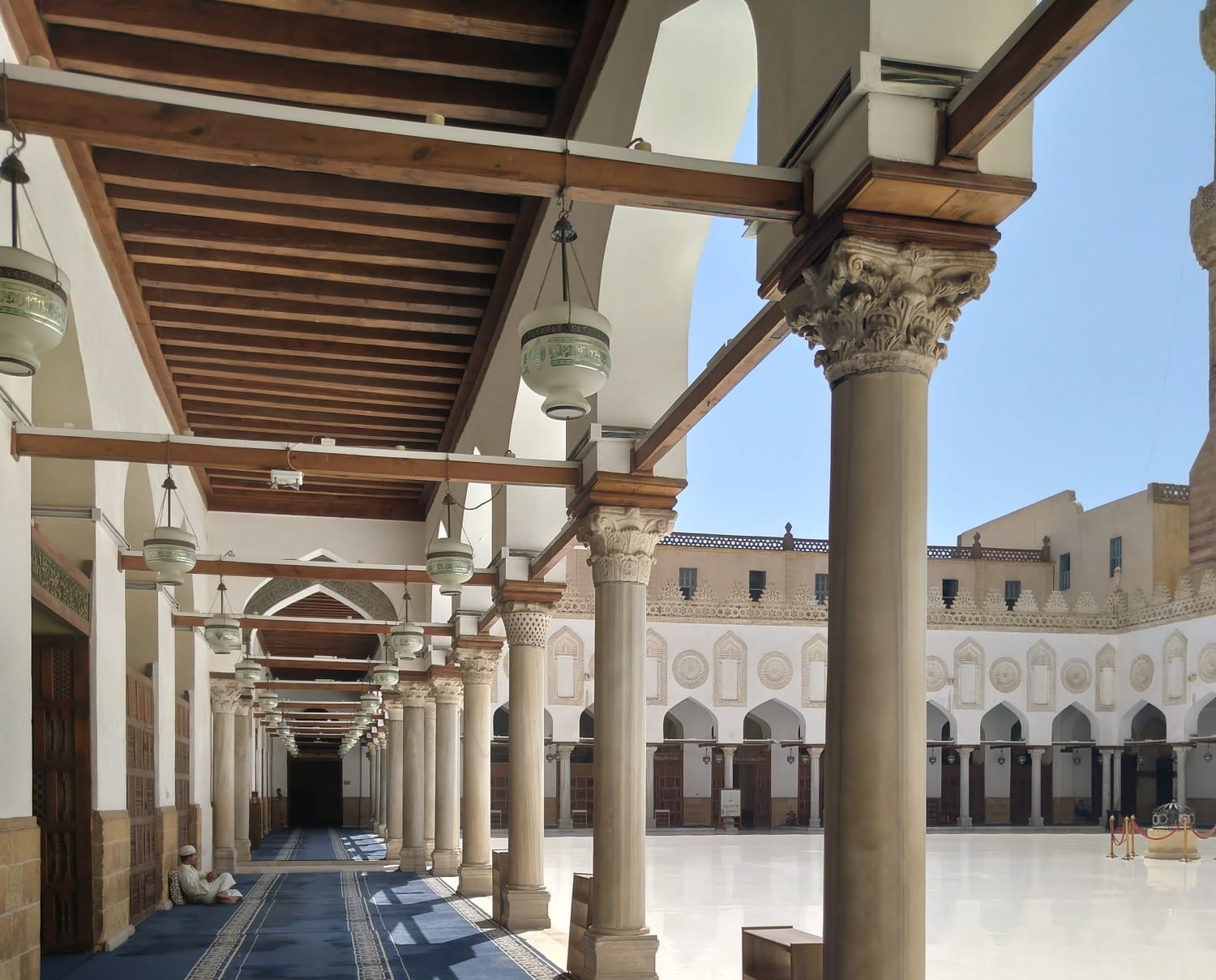
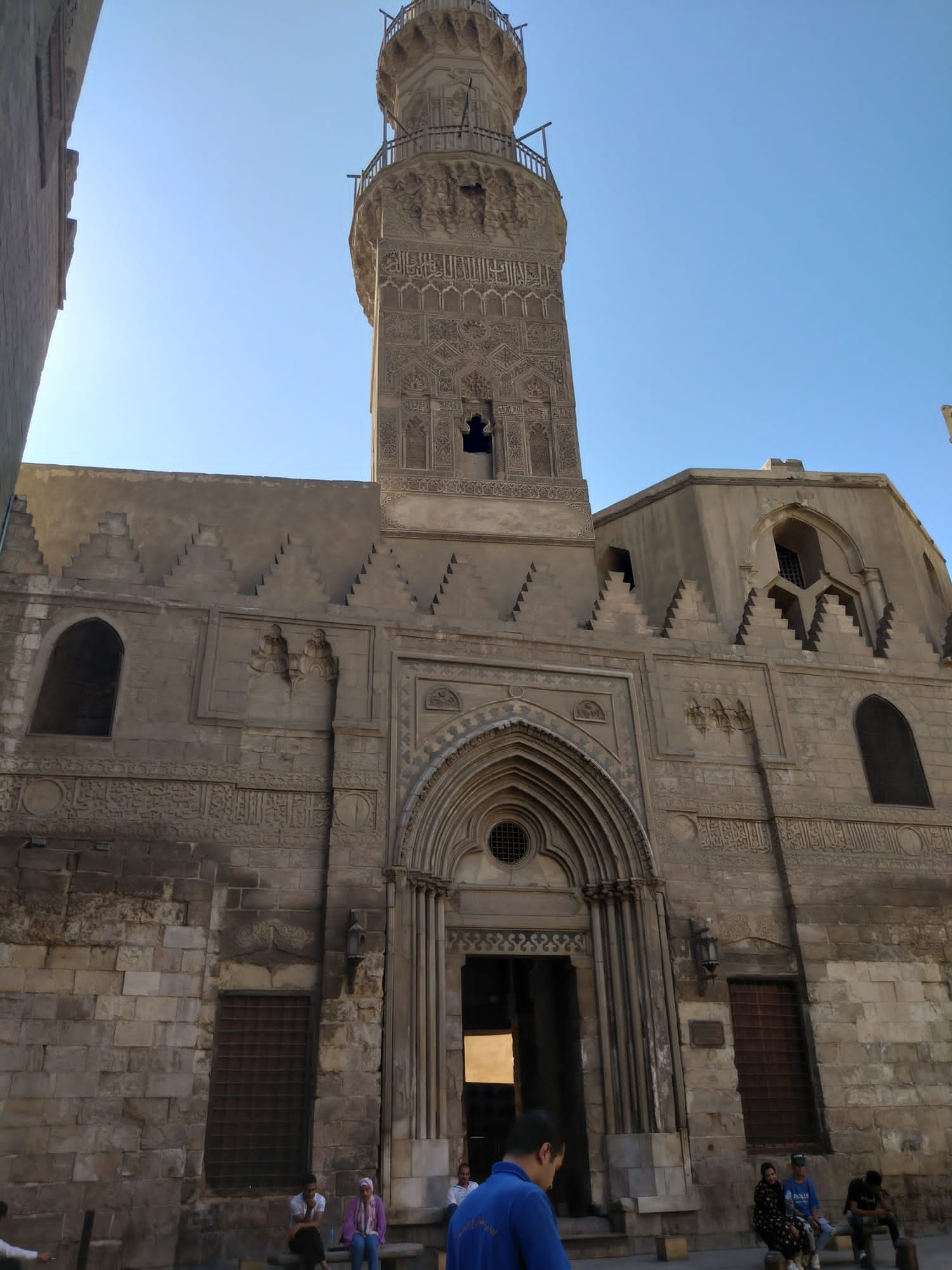
Swefy and a representative from the mosque's external relations department showed us around. Both spoke with great affection about the complex, founded in 971, two years after Cairo itself was founded. The mosque was completely empty. Not another person or tourist in sight: we had the place to ourselves. The first thing we noticed was the beautiful white tiled floor in the courtyard. The tiles were baking in the sun, yet felt cool. We were told that they were a special stone from Mecca, donated by Saudi Arabia.
We learnt about Islamic architecture and the different functions of the building, while seeing the beauty of this centuries-old mosque. The girls had questions. That is the wonderful thing about children: they are open to everything.
The men demonstrated and explained how they prayed. The girls listened carefully, without prejudice. They didn't find it strange. At most, they asked, 'But don't we just fold our hands and close our eyes?' When you are open to other people, you realise how much we share. I would rather focus on that than on what separates us. I am a Christian, but I am open to learning from others. That makes life valuable, and it is something I try to pass on to my children. Be open, explore, learn and still stay true to yourself.
Swefy spoke passionately. This was what he loved doing most. But because there were hardly any tourists, he was working in the Al-Azhar university library. When I heard people addressing him as 'doctor' in the street and asked him about it, he remained modest. He said he loved people coming to see 'his' Cairo. Swefy was one of many graduates unable to find the job they had trained for.
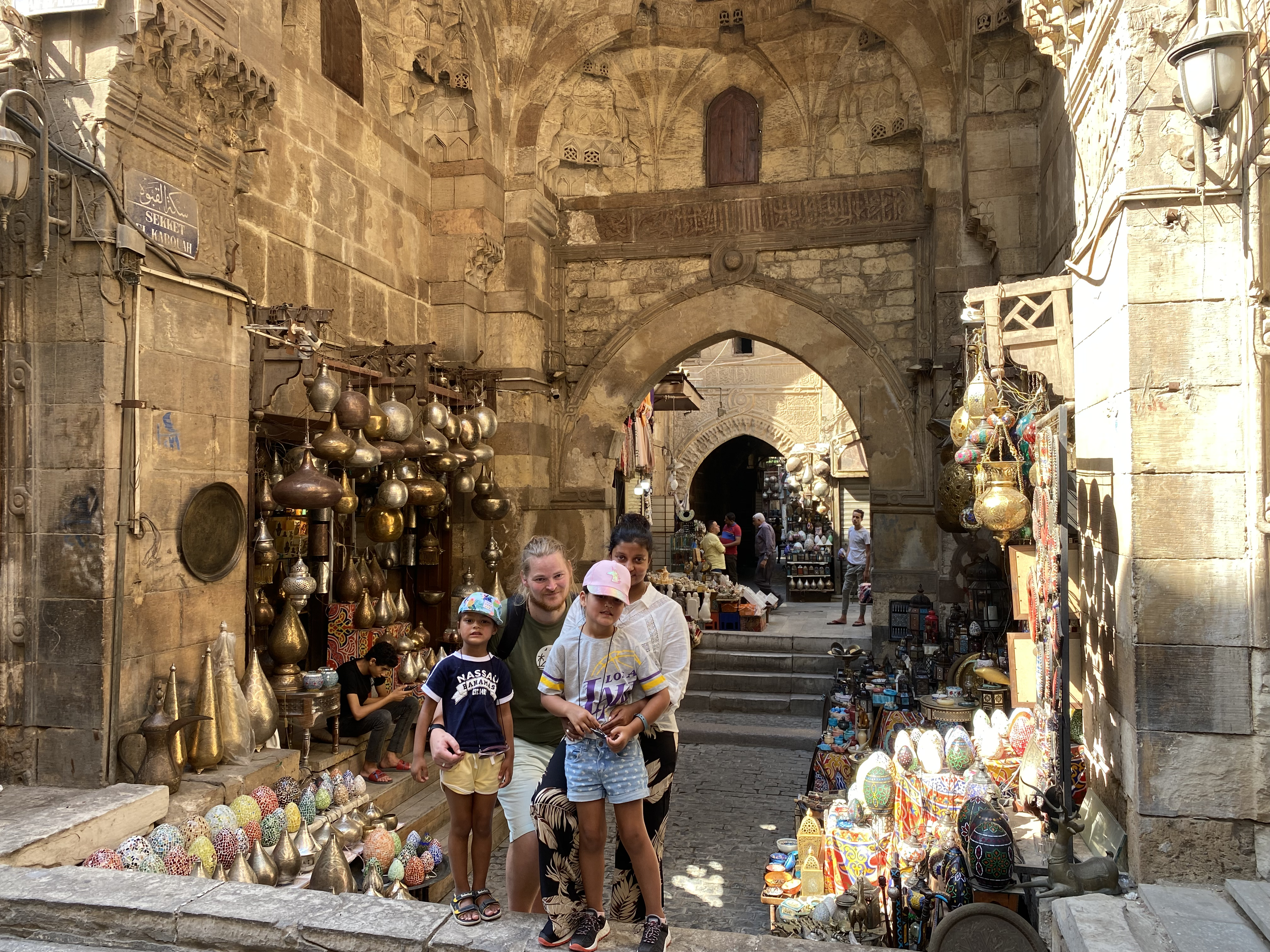
After visiting the mosque, he took us across the road to Khan el-Khalili. This huge souk in Egypt's capital dates from the late fourteenth century. In the past, trading caravans arrived from Africa, the Middle East and Asia. It takes its name from Emir Djaharks el-Khalili, a powerful Mamluk prince who first built the market in 1382. During Ottoman rule, it was also known as the Turkish Bazaar.
At our request, or rather the children's, we stopped for food first. Like so many places in Egypt, the market entrance had metal detectors. On my previous visit to Cairo, an attack had taken place a few weeks earlier. That visit involved a great many security measures: lots of police and checkpoints. Following the attack in 2009, the souk had gradually become less of a fortress. During this visit, there was just a metal detector at the entrances.
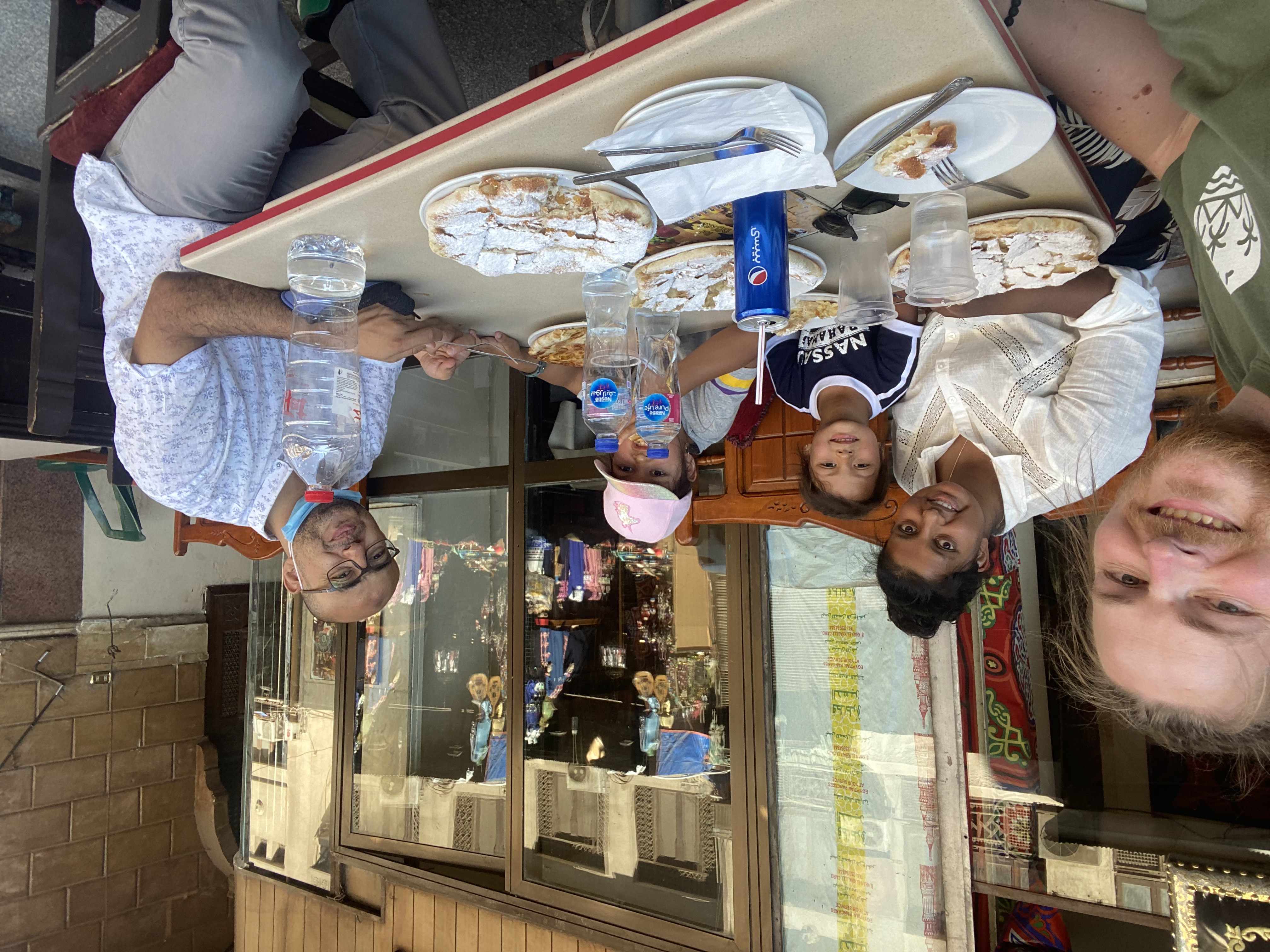
Swefy took us to a little place serving 'Egyptian pancakes'. The menu offered two options: sweet and savoury. The sweet ones were called Egyptian pancakes; the savoury ones Egyptian pizzas.
Jaïra chose a savoury pizza with what the menu described as Turkish cheese. Joëlla picked a banana pancake. We also ordered pancakes with coconut and with cream. Swefy joined us, of course. It is always lovely to share a meal with your guide. The five of us tucked into the four dishes. I can assure you, the food was delicious. It didn't resemble a pizza or pancake in any familiar sense. The pancakes were wonderfully crisp, somewhere between a pancake and puff pastry, with coconut, banana or cream inside. And, naturally, a layer of icing sugar on top.
Jaïra's pizza was much the same, but savoury. She loved it! She even happily ate the green chillies inside.
We had lovely conversations with Swefy over lunch. We also loved watching the girls happily tucking into their food in a little local place among Egyptian customers. We thoroughly enjoyed it!
Then came the question you know one of the children will ask, but hope won't arrive until you are back at the hotel. 'Mummy, I need the toilet.' The restaurant didn't have one, or rather, Swefy advised us not to use it. He offered to take our daughter to another place he knew. Very kind, but I preferred to go along. A few narrow alleyways later, the children were allowed inside to use a toilet. Problem solved, although after seeing it Jaïra said she could hold on a little longer.
After eating, we explored the market. There was a loose division between the tourist part and the section mainly used by local people. To the right of the main entrance, stalls mostly sold souvenirs, water pipes, gold and silver. To the left were clothes, household items, toys and spices for local customers. We walked through the market and veered left towards al-Mu'izz Street.
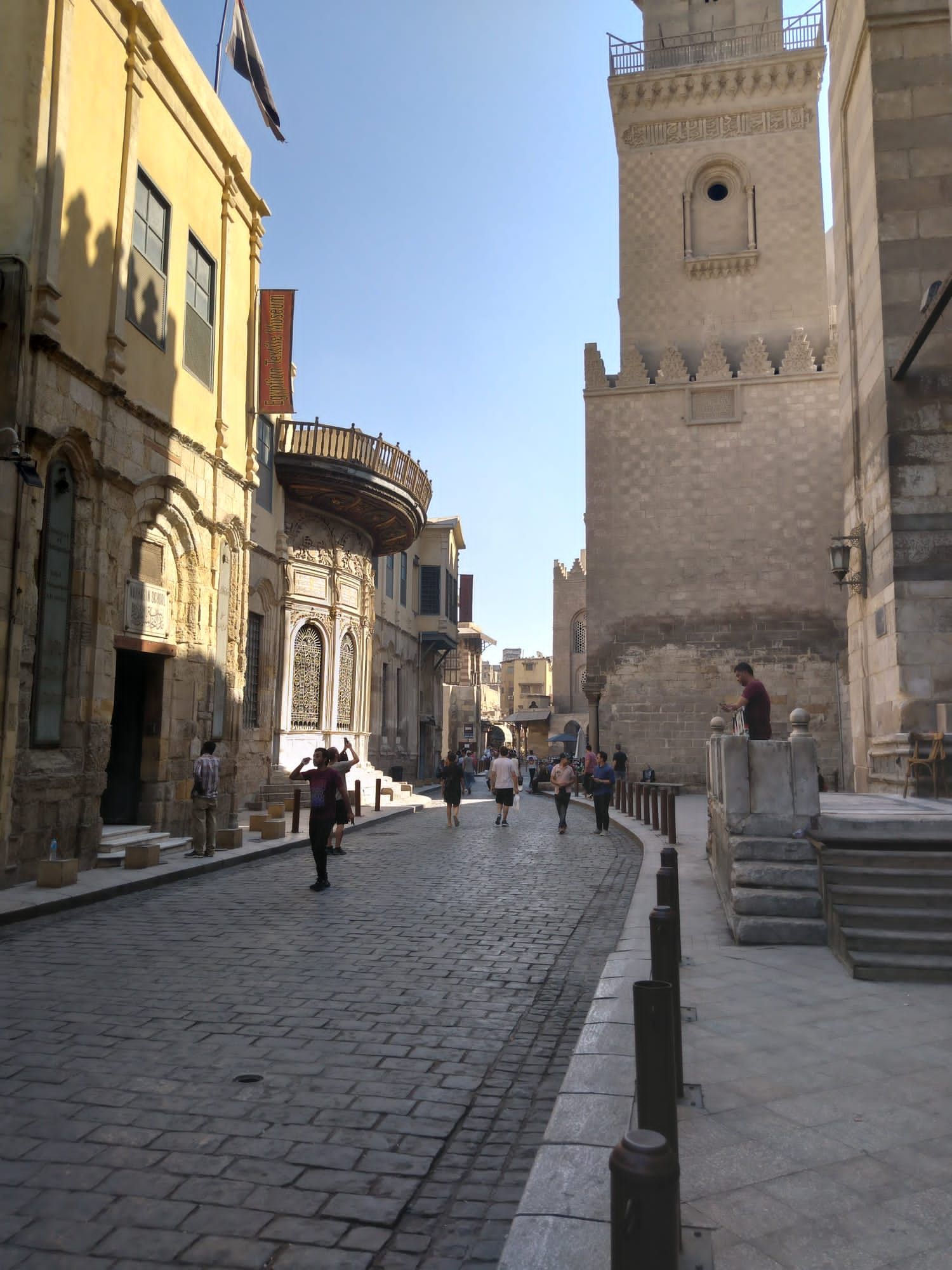
Here was the enormous Qalawun complex, built by Sultan al-Mansur Qalawun in 1284–1285. It includes a hospital, a madrasa or school, and a mausoleum. It is regarded as one of Islamic Cairo's major monuments and an important example of Mamluk architecture, both for its architecture and the scale of its charitable provision.
The streets around it were beautiful. Hardly any tourists came to this part of the city then. They had done before, but visitors were unusual during our trip. Egypt had barely begun recovering from the political unrest when COVID arrived. The children visibly enjoyed the narrow streets, shops, palaces and all the attention from local people.
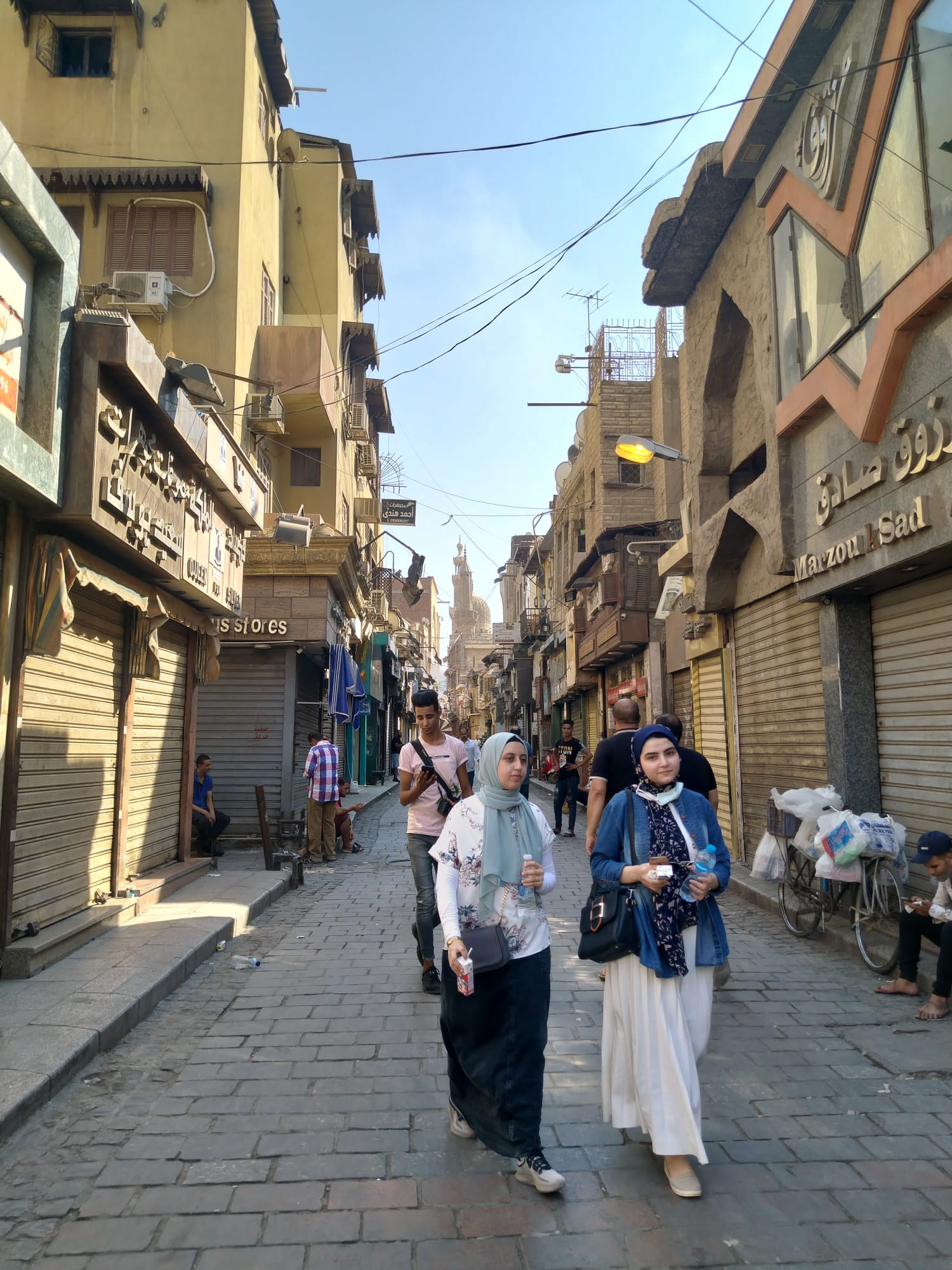
After a long walk, we returned towards our starting point with Swefy. He had one more place to show us. Behind Al-Azhar Mosque was another market, which he called the truly local market. That seemed about right. You were unlikely to encounter a tourist in these streets. The sandy lanes were covered in rubbish. Butchers chopped meat in front of their shops. For the first time in their lives, the children saw carcasses hanging up. They didn't find it particularly strange. They did think it smelled, and they certainly weren't wrong.
Everybody looked at us here. We felt very small. After a few streets, we stopped at a tiny shop selling handmade boxes. Wooden boxes with beautiful patterns made from polished shells. You see these elsewhere in the Middle East too; we had seen plenty in Jordan. Jaïra really wanted one for her earrings. She knew she had some money in her own little purse, and that spending it now meant she couldn't spend it later. She chose a box and proudly bought her Egyptian souvenir with the pocket money Grandma had given her.
In the next story, we'll take you to the pyramids of Giza and Djoser!
Egypt’s 80 pyramids!
Don't worry, I'm not going to describe all eighty pyramids in this story. But the title does show that there is more to say about them than you might expect. Here, we tell you about visiting the pyramids with the children during our backpacking trip through Egypt in the COVID-19 pandemic.
It was our third day in Egypt, and we had just finished breakfast. We were checking out of our Cairo hotel and going in search of the pyramids. We had deliberately put them near the beginning of our itinerary, so that the children would see these giants shortly after arriving. What could be more Egyptian than the pyramids?
I had contacted Egypt Tours Portal beforehand and agreed a good deal. They would collect us from our hotel in central Cairo, take us to the pyramids of Giza and then on to Djoser's pyramid at Saqqara. One particularly convenient arrangement was being dropped off at a different hotel afterwards. They didn't normally do that, but it is worth negotiating!
After just under an hour, the pyramids began to appear in the distance. The city really does surround these giants. When we arrived, we found what we had hoped for but hadn't quite expected: it was incredibly empty. There were exactly two coaches, and that was it. On my previous visits, there had been tens of thousands of tourists here every day. Egypt welcomed 14.7 million visitors in a year!
A little background: Egypt's pharaohs expected to become gods in the afterlife. To prepare, they built temples for the gods and enormous pyramid tombs for themselves, filled with everything each ruler might need to find their way and sustain themselves in the next world.
Pharaoh Khufu began the first pyramid project at Giza around 2550 BC.
The pyramids of Giza
The pyramids of Giza have done exactly what they were meant to do: last for an eternity. These monumental tombs are remains of Egypt's Old Kingdom, built roughly 4,500 years ago.
When you walk around here with children, don't expect them to listen to every word from the guide. The enormous pyramids attract their attention. Honestly, though, after ten minutes looking at this pile of stones, our children's attention began to wander.
Three tips:
Go as early in the morning as possible!
Don't forget a sun hat!
Go inside a pyramid!
As mentioned above, the first pyramid at Giza was built by Pharaoh Khufu around 2550 BC. This 147-metre-high pyramid is also known as the Great Pyramid. A little fact: it is estimated to contain 2.3 million stone blocks, weighing between 2.5 and 15 tonnes each!
The second pyramid was built by his son, Pharaoh Khafre, around 2520 BC. The Sphinx belongs to this complex too: the mythical lion with a pharaoh's head.
The third and smaller pyramid was built by Pharaoh Menkaure, around 2490 BC.
Inside the pyramid
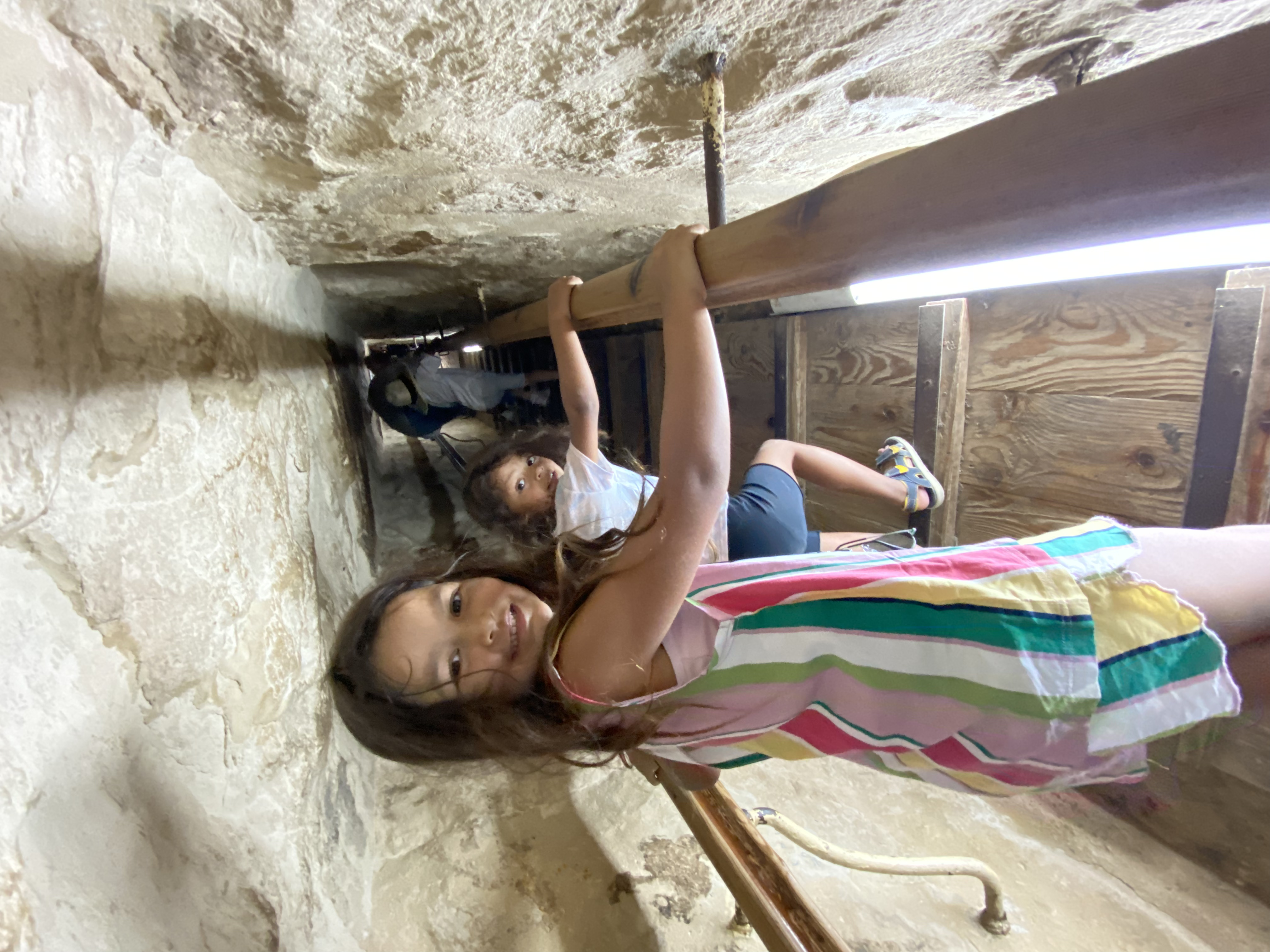
Was it worth it? Yes! Was it beautiful inside? Not really. We would still recommend visiting the inside with children. During our visit, it cost an extra €20 per adult. We had to leave our camera and video equipment behind, although phones were allowed. To reach the entrance, you first climb a short way up the pyramid. For the children, that was where the adventure began.
Once inside, the real adventure started. This was so much fun for the children! A winding passage led inwards. A little climbing and scrambling later, we reached a sloping 'staircase' about 160 metres long. The passages were narrow, roughly one metre by one metre. I would really suggest going in when it is quiet, because people travel in both directions…
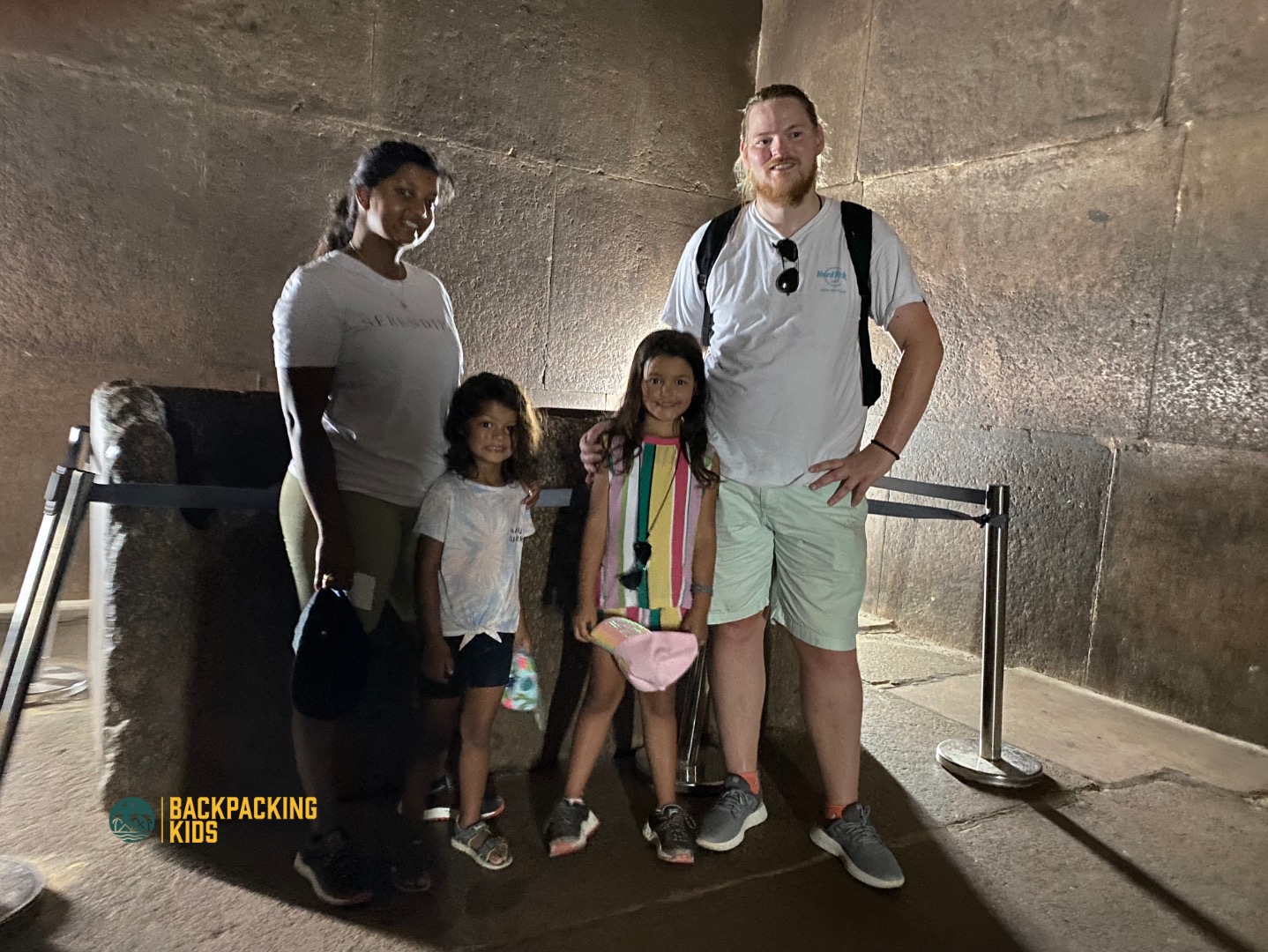
All the climbing and sweating, which happens very quickly with the temperature difference, was worth it. Although the chamber was completely empty apart from a sarcophagus, it may well have been the children's highlight.
After visiting the pyramids, we drove a little farther away. From there, we had a beautiful view: ideal for a photograph. Getting a picture without other tourists, as we could, would usually be difficult.
That was why I kept repeating it during that trip: go while it is so quiet!
In the next story, you can read about our visit to the Sphinx and finally to Djoser's pyramid.
Djoser: the reopened pyramid at Saqqara
Djoser: perhaps the name rings a bell. In the Netherlands, many people know it as the name of a travel company. That company takes its name from the pyramid at Saqqara. And that was where we went today!
Although Coconut, five, and Mango, four, had already loved the pyramid at Giza, they were very curious about the next stop. For new readers, Coconut and Mango are the nicknames of our daughters Jaïra and Joëlla.
Saqqara
Saqqara lies around a 45-minute drive south of the great pyramids of Giza, roughly thirty kilometres away. Historically, it is a city of the dead, or necropolis. This burial ground belonged to the former capital, Memphis. The drive wasn't particularly remarkable. The children used the time to close their eyes, because the heat really drains your energy.
Along the canal, there wasn't much to see, little traffic and no tourists at all. We felt as though we were in the middle of nowhere. That was partly because of COVID-19 and partly because summer simply isn't high season. During that trip, both seemed good reasons to travel with the children then. After leaving the main road, we drove through a huge area of beautiful date palms. They looked as though they had come straight out of a fairy tale. 'Look, Mango, this is where those delicious dates grow!' It was a lovely moment to wake them up again.
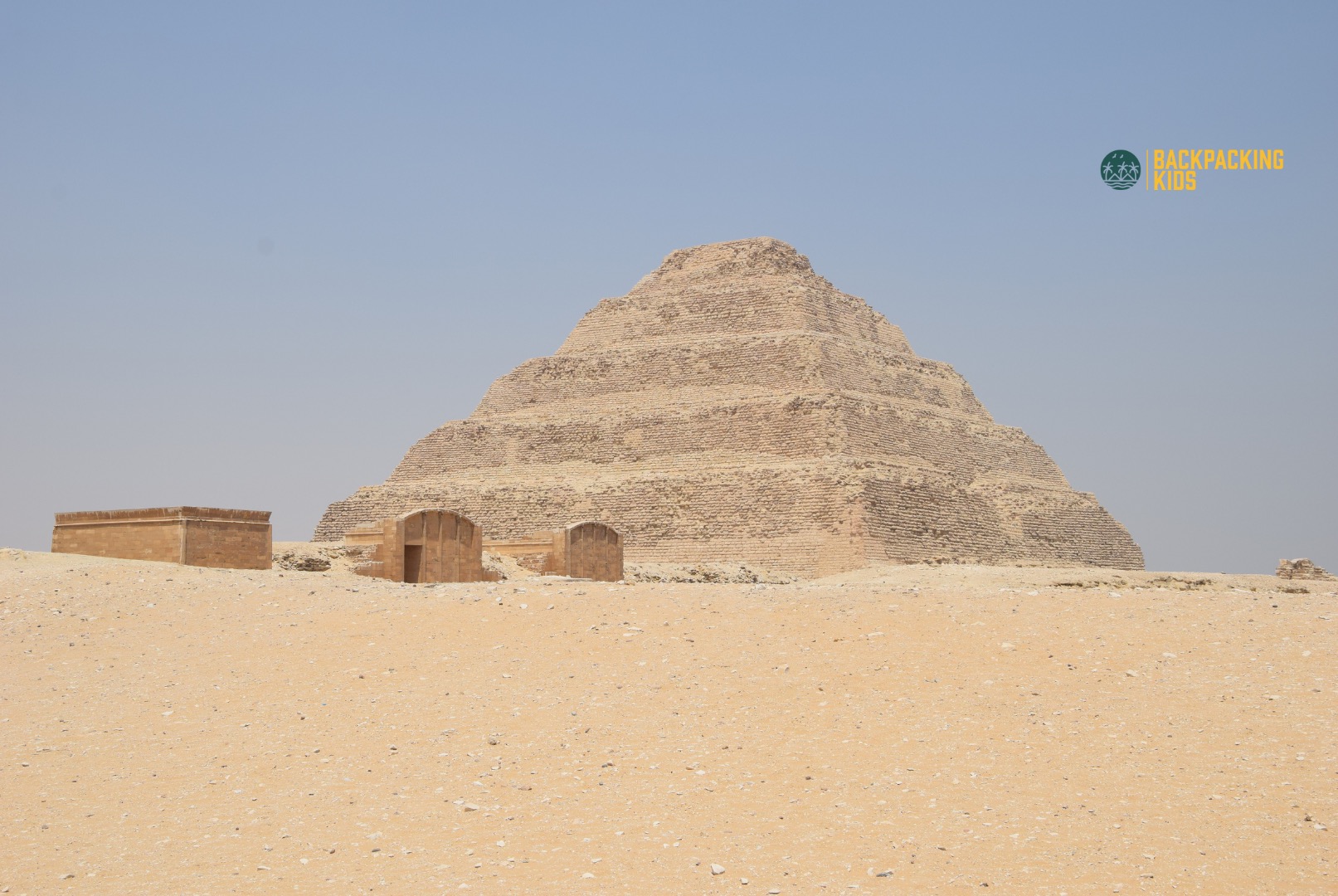
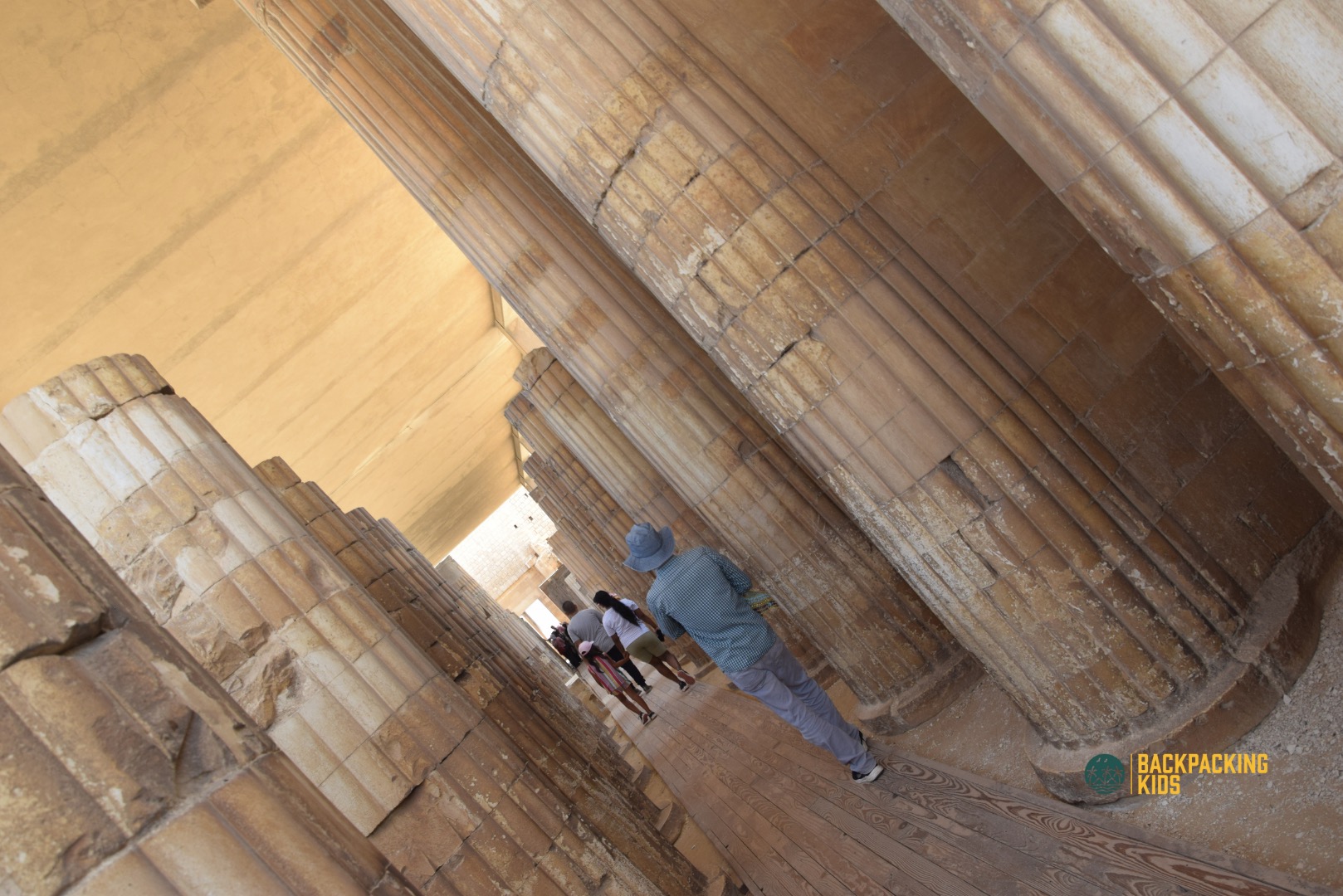
As we drove into the Saqqara site, about seven by one and a half kilometres in size, we had to pass checkpoints again. Each time, the soldiers seemed surprised that there were any tourists at all. Before long, Saqqara's pyramid appeared in the landscape. In many ways, we found this place much more beautiful than the Great Pyramid!
This was the first pyramid in ancient Egypt!
It is a step pyramid. Yes, a pyramid that looks like a staircase!
Saqqara could finally be visited again!
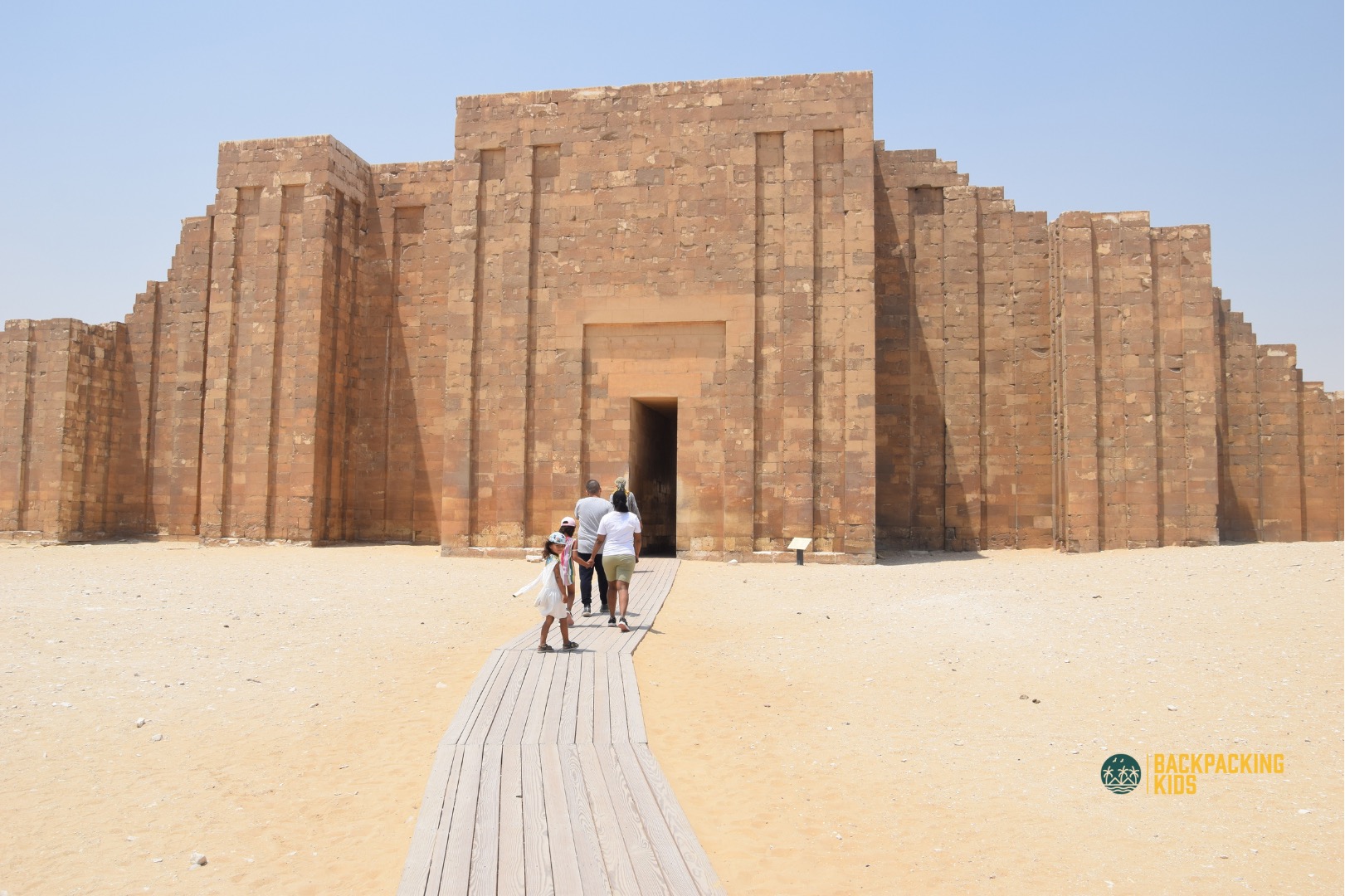
Saqqara had undergone fourteen years of restoration. It had taken longer than planned, and probably cost more than budgeted. But at last, we could go inside again! More about Djoser's pyramid ↗
Saqqara was a beautiful place. The relatively small pyramid made a wonderful sight. No large skyline behind it, no thousands of tourists and a beautiful desert landscape. We loved its simplicity.
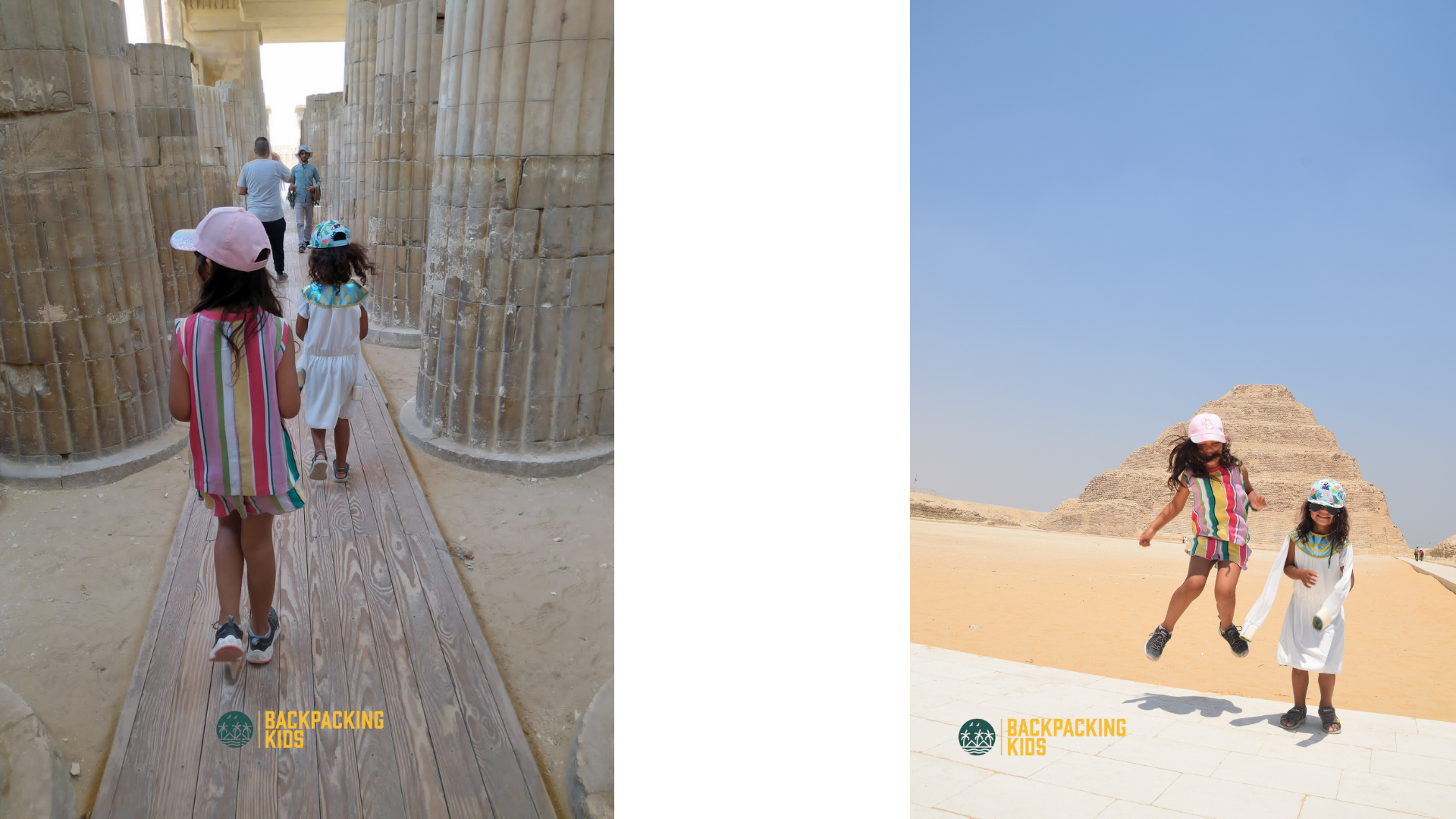
For the children, it might have been 'another' pyramid, but its easy accessibility made it ideal. Our girls enjoyed looking at it and taking photographs themselves. When their attention ran out, they turned to the sand and stones.
In the next story, we'll tell you more about our Egyptian lunch and the most beautiful hotel in all of Egypt!
More of Egypt
More of Egypt: from Giza to our last days in Cairo
At the Sphinx and dinner with a view
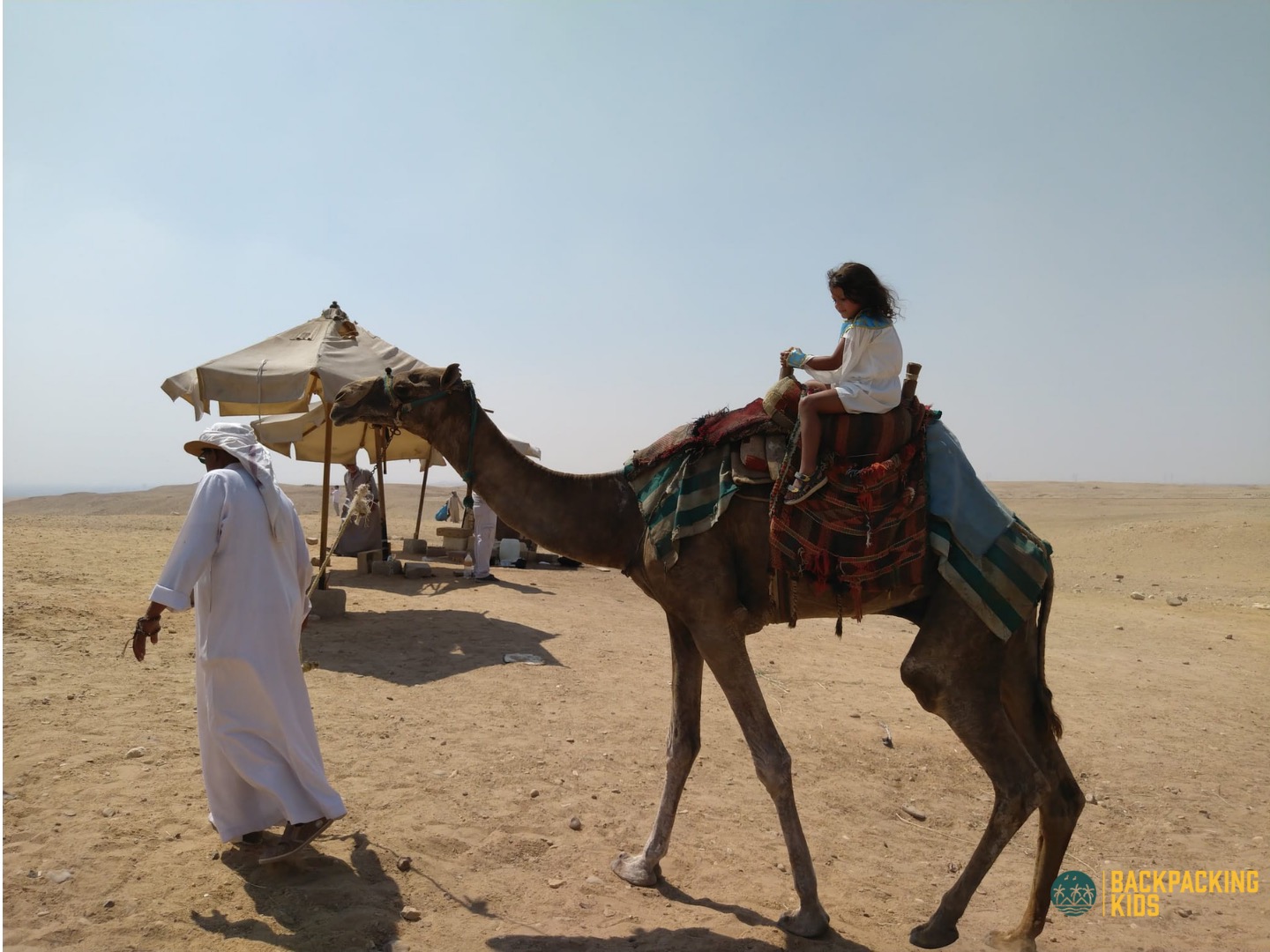
At the pyramids, four-year-old Joëlla climbed onto a dromedary without a moment’s hesitation. Straight on, and enjoying herself. Later, Jaïra posed by the Sphinx. Joëlla took the photograph. Both girls enjoyed taking their own pictures during this trip.
Behind the pyramids, we walked through streets with shops, hotels with striking lights and stretches with nothing much to see at all. Around one corner stood horses, while taxis drove past. In one of those streets, we found a rooftop restaurant where we could eat overlooking the pyramids.
The pyramids stayed in view that evening too. Egyptian food on the table, Arabic music in the background and the girls with us. At Marriott Mena House, we could even see them over breakfast.
Giza pyramids · 2021Giza pyramids · 2021The Sphinx · 2021
A few days in Soma Bay
After Cairo and Giza, we drove to the Red Sea. In 2021, many hotels were empty or closed. We decided to drive past Hurghada and chose Soma Bay, farther south. We stayed at Sheraton Soma Bay Resort.
I’m not much of a resort person, but this was a lovely stop for the girls. A large swimming pool, slides, a beach and big breakfasts. After travelling around, they could spend a few days swimming and playing.
We had another reason for coming here. We met people I had lived, worked and laughed with in Egypt before. This time, we sat down together with our families. It was lovely to see them.
We were less enthusiastic about the food at Sheraton. The pools were a success with the girls, but we don’t remember the food as one of the highlights of this trip.
While I took the girls swimming, Shamila had some time to herself. She began a diving course and went diving with Diving Ocean Makadi. After Sri Lanka, she could add Egypt to her diving list too.
The photograph shows her underwater. I was proud of her for doing this for herself.
One afternoon, we went out on the Red Sea in a catamaran. The water was 29 to 30 degrees and we saw lots of fish. That was brilliant!
Boats and swimming at Hilton Luxor
In Luxor, we stayed at Hilton Luxor Resort & Spa. From the hotel, we looked across the Nile to the opposite bank. After a morning out, the girls went into the pool. With these temperatures, we were ready for a swim too.
We also returned to the hotel by boat one day. On the Nile, the girls had plenty of room to snuggle up to Mum. Then it was time for more swimming and something to eat. That combination worked very well for them.
What we remember most is the help from the woman at reception. When Joëlla had stomach pains, she helped us and arranged for medicine to be brought to the hotel. She really made a difference. As far as we were concerned, she deserved a sixth star.
Hilton Luxor · 2021Hilton Luxor · 2021Luxor and the Nile · 2021
The Valley of the Kings with the girls
It was 43 degrees at the Valley of the Kings. Hats on, water packed, and a bit of effort to keep the girls interested. Fortunately, that last part went well. They found it exciting to enter the tombs and walk deep into the hillside.
In Merenptah’s tomb, we went treasure hunting. There were hardly any other visitors. The depth of the tomb impressed the girls. They wanted to discover what lay farther inside.
Meanwhile, I tried to tell them all sorts of things about the hieroglyphs. Whether I should ever become a professional guide is another question. These two thought I was a perfectly good guide, at least. They looked, asked questions and wanted to know more.
The Valley of the Kings lies on the west bank near Luxor. Many pharaohs of the New Kingdom were buried here. You can see the painted corridors and burial chambers clearly in our photographs.
Valley of the Kings · 2021Valley of the Kings · 2021
The Temple of Hatshepsut
The cameras came with us to the Temple of Hatshepsut too. Joëlla took a photograph of the painted columns and walls herself. I loved seeing her pay such attention to what was around her at that age.
Hatshepsut was a woman who became pharaoh. Her temple stands at Deir el-Bahari, on the west side of Luxor. Its three terraces rise towards the cliff face. That temple is a masterpiece.
We also visited Luxor Temple. Among the huge columns, you can see how much was built and changed here over the centuries. Amenhotep III and Ramses II left their marks, but the story didn’t end there.
In Roman times, the temple and its surroundings became part of a fort. One of the inner rooms was decorated with paintings of the emperor and his fellow rulers. That later history is part of this place too.
The temple stands on the east bank of the Nile. Karnak lies a few kilometres to the north. We visited both during our days in Luxor.
As far as we’re concerned, you can skip Banana Island near Luxor. Looking at the banana plants was fun. Then they proudly showed us the animals.
There were monkeys in a cage that was far too small. Two large crocodiles were kept in an old well, about two and a half metres across. We wouldn’t go back for that. Not every excursion in Egypt is one we would recommend.
Banana Island · 2021
Karnak with the girls
At Karnak, we went looking for hieroglyphs. I knelt by a wall to tell the girls about everything we could see. Four and five years old, yet they stood there studying those stones. They asked the loveliest questions.
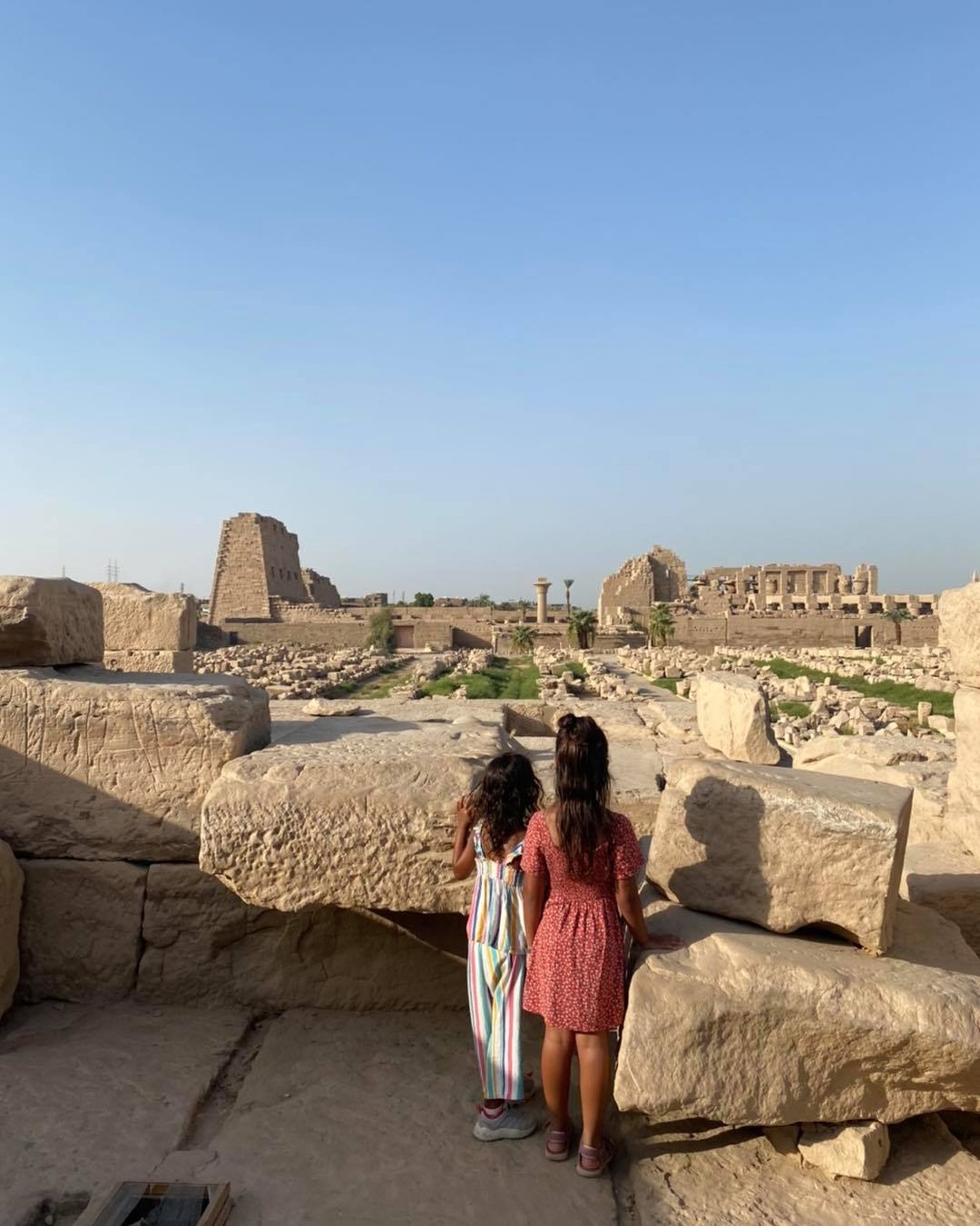
There were hardly any tourists. We were even allowed a brief look at an area where restoration work was taking place, normally closed to visitors. In the photograph, the girls are standing among the huge stones.
One of the girls reacted enthusiastically to a story about a queen: “A queen? I like that, a woman! Can we have our photograph taken together, Mummy?”
Karnak stands on the east bank of the Nile near Luxor. It is a large complex with several temples and chapels. The Temple of Amun was one of the most important.
Karnak near Luxor · our 2021 trip · open the photograph
Kom Ombo in 45-degree heat
After Luxor, we drove farther south. Edfu had been on our itinerary, but we skipped that stop. It had been incredibly hot for several days, and the farther south we went, the hotter it became. We chose to continue to Kom Ombo.
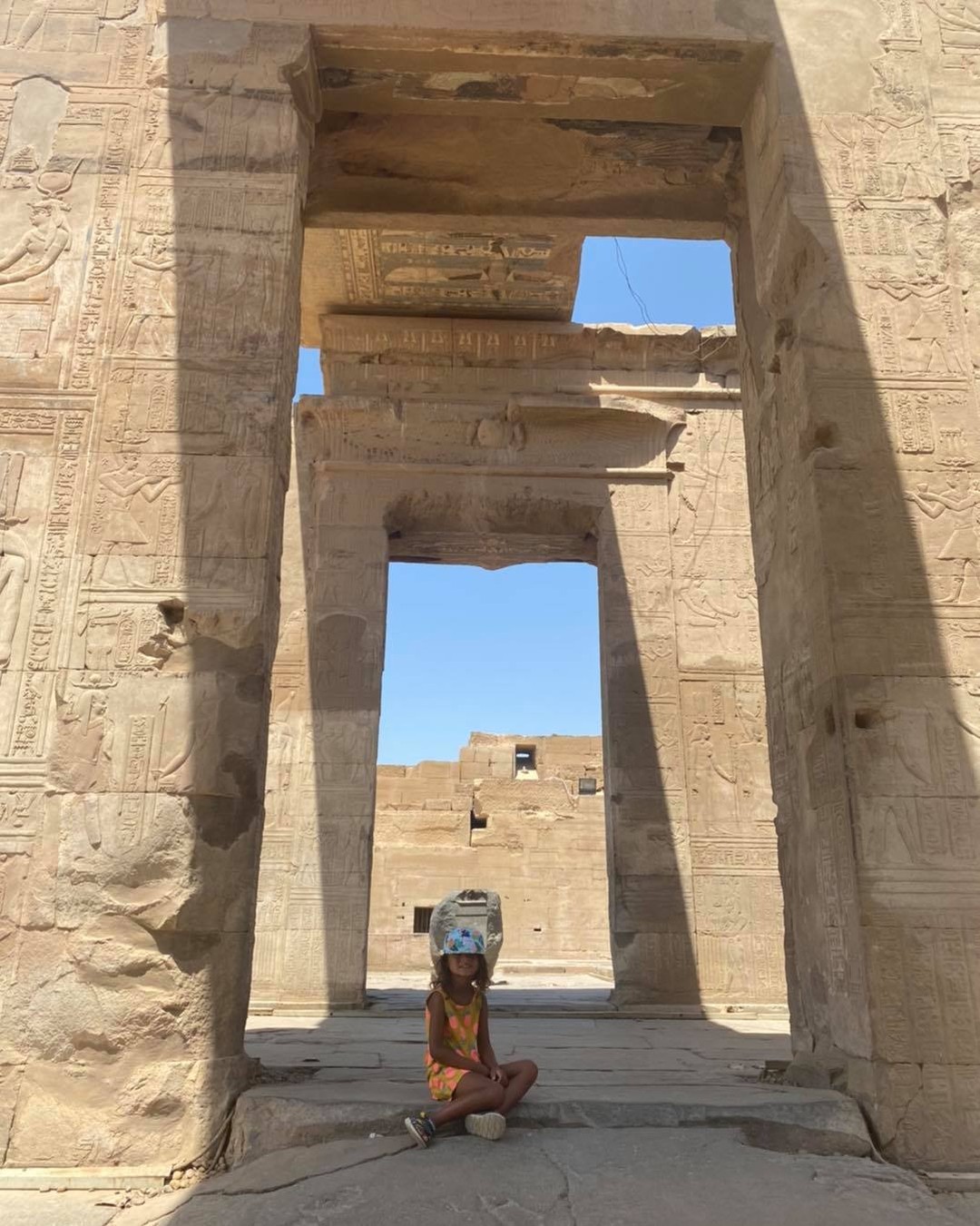
It was 45 degrees at the temple. According to the people there, we were the first tourists in weeks. That meant we could look around quietly, but of course it was terrible for the people earning their living here. We kept a close eye on the girls in that heat.
The temple is dedicated to two gods: Sobek, the crocodile god, and Horus the Elder, the falcon god. The building standing today dates from the Graeco-Roman period.
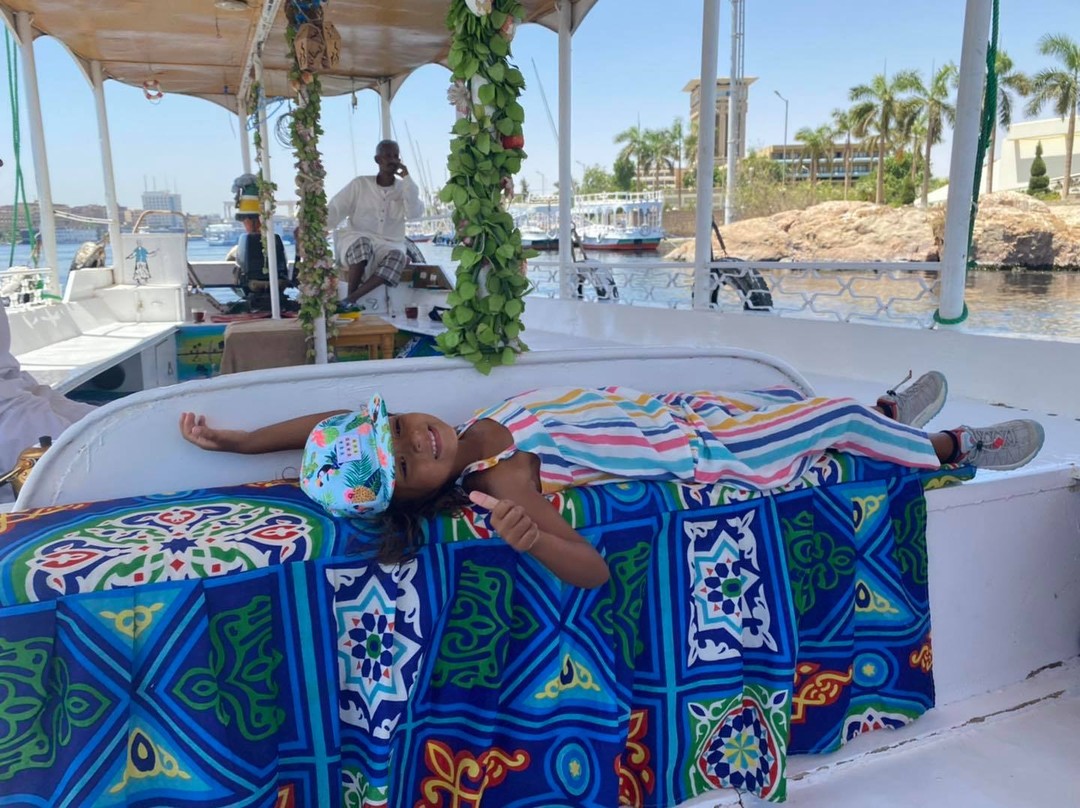
Whenever we arrived at our hotel by ferry, Hammid would kindly ask whether we wanted to take a trip with him. On our last day in Aswan, we decided to sail around Elephantine with him. For less than ten euros, we had a boat to ourselves for two hours.
Read moreRead less
On one side, we saw the tombs of the nobles and the botanical gardens. On the other were Nubian villages. We drank tea while Hammid told us about his life and his Nubian heritage. He had plenty to say and took his time.
When we said goodbye, he gave each of the girls a Nubian hat. They hadn’t been bought in a souvenir shop: they were a gift from the man we had just spent time with on the Nile.
We had found our driver, Abu Bakr, through contacts in Egypt. In Luxor, he could stay with family. In Aswan, we arranged and paid for a room for him at The Mango Guest House. We stayed at Mövenpick ourselves. After we checked in, Shamila took the girls swimming. I went with Abu to arrange his room.
The guesthouse was on the same island, only about a hundred and fifty metres from our hotel as the crow flies. Even so, we first had to take the ferry to the mainland, then a local boat back to the island. Because of COVID, the hotel was separated from Elephantine’s inhabited area. Hotel guests weren’t really supposed to go there, and residents weren’t allowed into the hotel.
After checking him in, I thought I would simply walk back to Mövenpick. I walked through some incredibly remote little streets and eventually reached the hotel. But there I stood, facing a locked gate. Nobody would open it. I couldn’t climb around it either.
Eventually, I saw two fishermen with a boat. I asked how much they wanted to take me to the main entrance. They did, but only after plenty of bargaining. What should have been a short walk back became another boat trip around the island.
Afterwards, we took the overnight train to Cairo. Sleeping in bunk beds while the train moved was something the girls were very excited about. We arrived at around a quarter to ten, about three hours later than planned. The windows were so dirty that the view was disappointing. Fortunately, we could still spot Djoser’s pyramid along the way.
Aswan and Elephantine · our 2021 trip · open the photograph
The High Dam and Lake Nasser
It was 44 degrees at the High Dam in Aswan. A quick family photograph, then on we went. Behind the dam lies Lake Nasser, an enormous reservoir that formed in the 1960s.
Its construction changed a great deal for Nubia. Villages were flooded and many residents had to move. Temples threatened by the rising water were relocated. Abu Simbel is the best-known example.
That history also came up in the stories we heard in Aswan. People spoke with great pride about their Nubian heritage.
Aswan High Dam · 2021
An early start for Abu Simbel
By a quarter to five, we were already on the ferry. At five, we set off with Abu. Abu Simbel was about three hundred kilometres through the desert from Aswan.
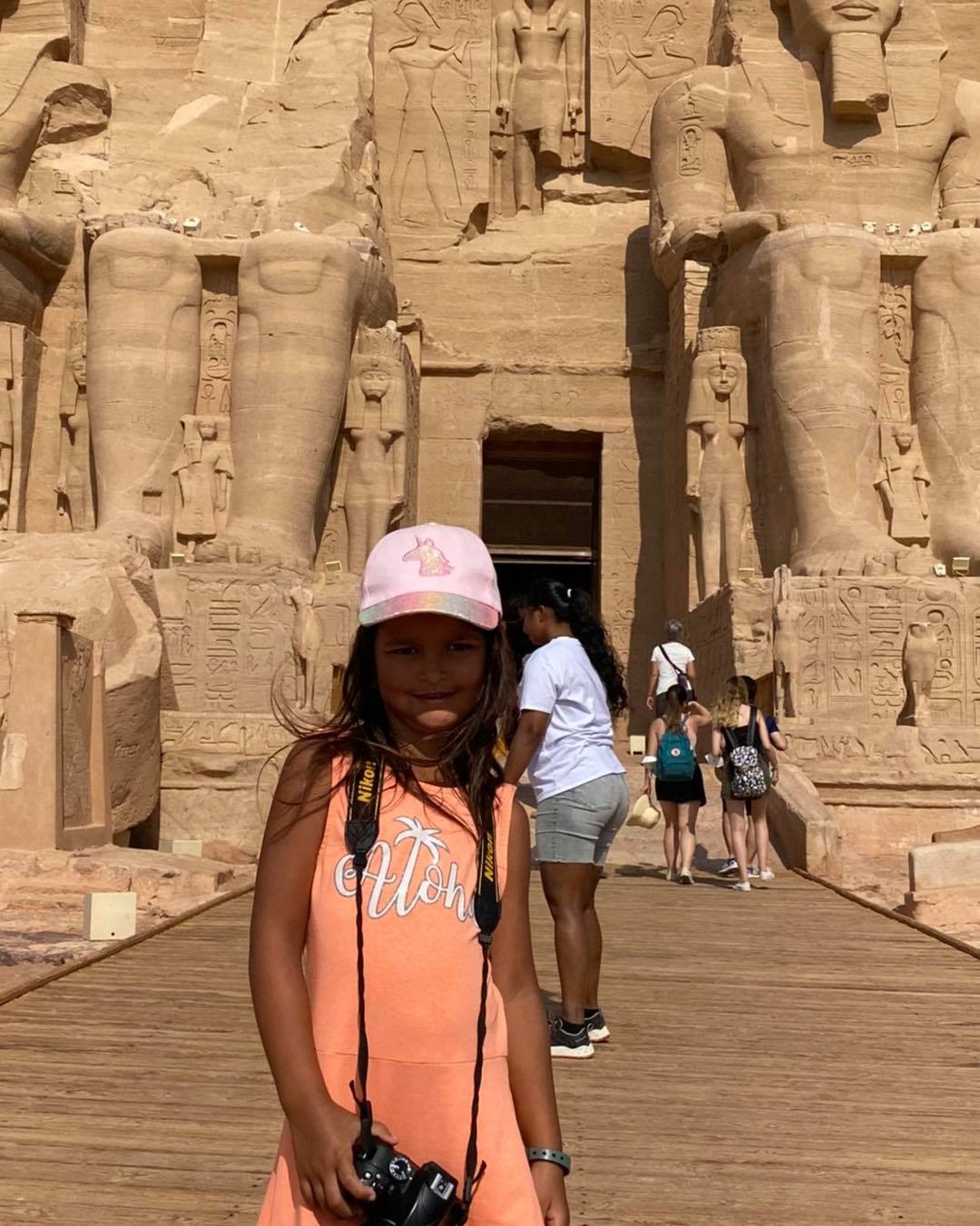
There we stood, in front of those enormous statues of Ramses II. The girls had brought their camera. We had to get up early and drive a long way, but this was somewhere we really wanted to show them.
Abu Simbel has two temples from the reign of Ramses II. The smaller temple is dedicated to Queen Nefertari. They stand beside Lake Nasser, south of Aswan.
From Luxor onwards, Joëlla had stomach pains for a few days. You don’t see that in every photograph, but it was part of the trip. She remained incredibly sweet, and we adjusted our days. We spent plenty of time in the minibus so she could sleep along the way.
We took things more slowly in Aswan too. When she saw McDonald’s and suddenly really wanted chicken nuggets, we decided to go there. After taking her medicine, she could choose something she actually felt like eating.
At Mövenpick Resort Aswan, we were upgraded to the presidential suite. The hotel was delighted to welcome children again and did all sorts of things to make us feel at home. Joëlla could rest while I took Jaïra to the pool. With 44 degrees outside, even the 29-degree pool water was welcome.
Mövenpick and the village · 2021
Back in Cairo, this time at the Marriott
After the overnight train, we were back in Cairo. This time, we chose Cairo Marriott Hotel & Omar Khayyam Casino. At our first hotel, even crossing the road had been quite an undertaking. Jaïra found the traffic frightening. We wanted somewhere quieter for these last few days.
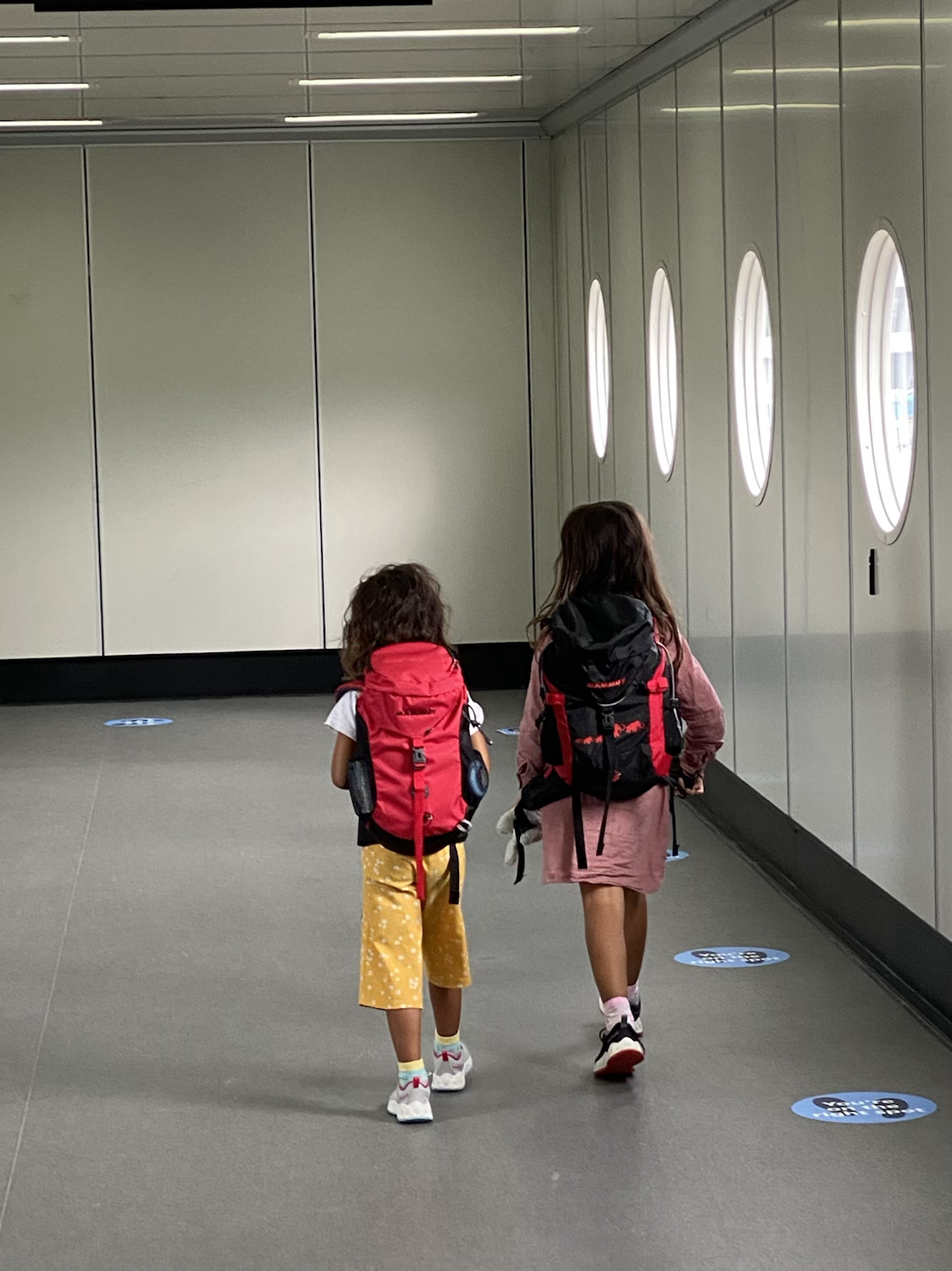
The girls carried their own backpacks out of the station. Plenty of people were ready to help for a small tip, but they managed perfectly well themselves. I was proud of them.
After the long train journey, we still went into the city. We needed to buy a birthday present for Grandma too. And once we were back at the hotel, someone was soon in the swimming pool.
At the Citadel, we visited the Muhammad Ali Mosque and the Al-Nasir Muhammad Mosque. You can see the large Muhammad Ali Mosque from far away. It was built in the nineteenth century and has two tall minarets.
Personally, we didn’t find it Cairo’s most impressive mosque. Perhaps because it was “only” about two hundred years old. There are more beautiful mosques in this city, in our opinion.
At the Al-Nasir Muhammad Mosque, Jaïra was busy taking photographs. She had my phone and pointed the camera at us. Meanwhile, we took photographs of her. She enjoyed it more and more as the trip went on.
In Coptic Cairo, we walked among old churches and narrow streets. We visited the Hanging Church and the Church of St Barbara, among others. The Ben Ezra Synagogue also appeared in our photographs from this part of the city.
The Hanging Church takes its name from where it was built: above the remains of the old Roman fortress. Several churches stand close together here, so you can see a great deal on foot.
At the Church of St Barbara, both boys and girls came up to me. They wanted a photograph with me. Perhaps it had something to do with my red YHWH shirt, but I still don’t know.
The girls enjoy trying food when we travel. At lunch in Coptic Cairo, there was koshari on the table: rice, pasta, lentils, chickpeas and fried onions. Joëlla chose Egyptian chicken shawarma. And yes, there was a plate of chips too.
In Saqqara, a fresh date made Joëlla very happy. Both girls had loved them ever since our trip to Israel and Palestine. A meal didn’t have to be complicated to go down well.
In Luxor, we ate Oumm Ali. This traditional Egyptian dessert was so good that I called it the tastiest dessert you could eat. That bowl in the photograph was certainly a success.
Coptic Cairo · 2021Saqqara · 2021Luxor and the Nile · 2021
Snow and games on our last day
Our last day was for the girls. Someone had suggested the Mall of Egypt, a large shopping centre outside Giza. We played in the snow there. In Egypt. That still felt like a strange combination.
We also went to an indoor play area and finished in the arcade. After all the temples and museums, it was a very enjoyable end to the trip for the girls.
I found the contrast enormous. We had seen so much poverty and were suddenly walking among shops and an abundance of luxury. That is part of Egypt too. Meanwhile, the girls enjoyed their afternoon playing.